Application
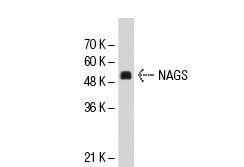
Western blot analysis of NAGS expression in Hep G2 whole cell lysate.| Product Name | NAGS Antibody (L-17) |
|---|---|
| Antibody Type | Primary Antibodies |
| Antigen Alias | raised against NAGS of human origin |
| Modification Notes | The function of the urea cycle is to remove excess nitrogen from the body. Six distinct enzymes comprise the urea cycle, and urea cycle disorders (UCD) are a direct results of deficiency in any one of those enzymes. N-acetylglutamate synthase (NAGS) catalyzes the conversion of N-acetylglutamate (NAG) from glutamate and acetylcoenzyme A. NAG is an obligatory activator of carbamylphosphate I (CPSI), the first and rate limiting enzyme of ureagenesis. Therefore, deficiency of NAGS results in severe hyperammonemia. Twenty one mutations have been described in humans, ten of which are associated with acute neonatal hyperammonemia, and the remainder found in patients with late onset disease. Treatment with N-carbamylglutamate (NCG) can ameliorate hyperammonemia for inherited and secondary NAGS deficiency. Expression of NAGS occurs in the liver, small intestine and kidney. |
| Clonality | Polyclonal |
|---|---|
| Isotype | IgG |
| Host Species | Rabbit |
| Tested Applications | WBIPELISA |
| recommended for detection of NAGS of mouse, rat, human and canine origin by WB, IP and ELISA: |
|
| Species Reactivity | HumanMouseRat |
| Concentration | 1mg/ml |
| Purification | Affinity purified |
| Alternative Names | raised against NAGS of human origin |
|---|---|
| Tissue Specificity | raised against NAGS of human origin |
| Entrez Gene | 162417 |
|---|
Application
Western blot analysis of NAGS expression in Hep G2 whole cell lysate.| Application Notes | recommended for detection of NAGS of mouse, rat, human and canine origin by WB, IP and ELISA: |
|---|
| Form | Liquid |
|---|---|
| Storage Instructions | For short-term storage, store at 4° C. For long-term storage, aliquot and store at -20ºC or below. Avoid multiple freeze-thaw cycles. |
| Storage Buffer | phosphate buffered saline , pH 7.4, 150mM NaCl, 0.02% sodium azide and 50% glycerol. |


