Application
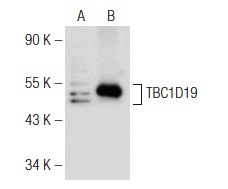
Western blot analysis of TBC1D19 expression in non-transfected: (A) and human TBC1D19 transfected: (B) 293T whole cell lysates.| Product Name | TBC1D19 Antibody (E-13) |
|---|---|
| Antibody Type | Primary Antibodies |
| Antigen Alias | epitope mapping within an internal region of TBC1D19 of human origin |
| Modification Notes | TBC1D19 (TBC1 domain family member 19) is a 526 amino acid protein that contains one Rab-GAP TBC domain and may act as a GTPase-activating protein for Rab family proteins. The gene that encodes TBC1D19 contains 178,915 bases and maps to human chromosome 4p15.2. Chromosome 4 represents approximately 6% of the human genome and contains nearly 900 genes. Notably, the Huntingtin gene, which is found to encode an expanded glutamine tract in cases of Huntington's disease, is on chromosome 4. FGFR-3 is also encoded by a gene located on chromosome 4 and has been associated with thanatophoric dwarfism, achondroplasia, Muenke syndrome and bladder cancer. Chromosome 4 is tied to Ellis-van Creveld syndrome, methylmalonic acidemia and polycystic kidney disease. |
| Clonality | Polyclonal |
|---|---|
| Isotype | IgG |
| Host Species | Rabbit |
| Tested Applications | WBIPIFELISA |
| recommended for detection of TBC1D19 of mouse, rat and human origin by WB, IP, IF and ELISA non cross-reactive with other TBC1D family members also reactive with additional species, including equine, canine, bovine, porcine and avian: |
|
| Species Reactivity | HumanMouseRat |
| Concentration | 1mg/ml |
| Purification | Affinity purified |
| Alternative Names | epitope mapping within an internal region of TBC1D19 of human origin |
|---|---|
| Tissue Specificity | epitope mapping within an internal region of TBC1D19 of human origin |
| Entrez Gene | 55296 |
|---|
Application
Western blot analysis of TBC1D19 expression in non-transfected: (A) and human TBC1D19 transfected: (B) 293T whole cell lysates.| Application Notes | recommended for detection of TBC1D19 of mouse, rat and human origin by WB, IP, IF and ELISA non cross-reactive with other TBC1D family members also reactive with additional species, including equine, canine, bovine, porcine and avian: |
|---|
| Form | Liquid |
|---|---|
| Storage Instructions | For short-term storage, store at 4° C. For long-term storage, aliquot and store at -20ºC or below. Avoid multiple freeze-thaw cycles. |
| Storage Buffer | phosphate buffered saline , pH 7.4, 150mM NaCl, 0.02% sodium azide and 50% glycerol. |


