Application
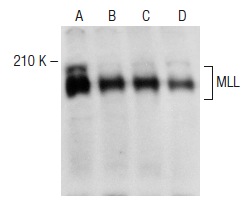
Western blot analysis of MLL expression in CCRF-CEM (A), Jurkat (B), MOLT-4 (C) and Ramos (D) nuclear extracts.| Product Name | MLL Antibody (H-300) |
|---|---|
| Antibody Type | Primary Antibodies |
| Antigen Alias | epitope corresponding to amino acids 3301-3600 mapping within an internal region of MLL of human origin |
| Modification Notes | Eukaryotic RNA polymerase II mediates the synthesis of mature and functional messenger RNA. This is a multistep process, called the transcription cycle, that includes five stages: preinitiation, promoter, clearance, elongation and termination. Elongation is thought to be a critical stage for the regulation of gene expression. ELL (11-19 lysine-rich leukemia protein, also designated MEN) functions as an RNA polymerase II elongation factor that increases the rate of transcription by suppressing transient pausing by RNA polymerase II. Also, ELL is thought to regulate cellular proliferation. ELL is abundantly expressed in peripheral blood leukocytes, skeletal muscle, placenta and testis, and has lower expression in spleen, thymus, heart, brain, lung, kidney, liver and ovary. The gene encoding human ELL, which maps to chromosome 19p13.1, is one of several genes which undergo translocation with the MLL gene on chromosome 11q23 in acute myeloid leukemia. MLL (myeloid/lymphoid leukemia, also designated ALL-1 and HRX) regulates embryonal and hematopoietic development. |
| Clonality | Polyclonal |
|---|---|
| Isotype | IgG |
| Host Species | Rabbit |
| Tested Applications | WBIPIFELISA |
| recommended for detection of MLL of mouse, rat and human origin by WB, IP, IF and ELISA also reactive with additional species, including canine, bovine and porcine: |
|
| Species Reactivity | HumanMouseRat |
| Concentration | 1mg/ml |
| Purification | Affinity purified |
| Alternative Names | epitope corresponding to amino acids 3301-3600 mapping within an internal region of MLL of human origin |
|---|---|
| Tissue Specificity | epitope corresponding to amino acids 3301-3600 mapping within an internal region of MLL of human origin |
| Entrez Gene | 4297 |
|---|
Application
Western blot analysis of MLL expression in CCRF-CEM (A), Jurkat (B), MOLT-4 (C) and Ramos (D) nuclear extracts.| Application Notes | recommended for detection of MLL of mouse, rat and human origin by WB, IP, IF and ELISA also reactive with additional species, including canine, bovine and porcine: |
|---|
| Form | Liquid |
|---|---|
| Storage Instructions | For short-term storage, store at 4° C. For long-term storage, aliquot and store at -20ºC or below. Avoid multiple freeze-thaw cycles. |
| Storage Buffer | phosphate buffered saline , pH 7.4, 150mM NaCl, 0.02% sodium azide and 50% glycerol. |


