Application
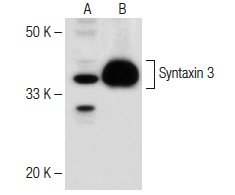
Western blot analysis of Syntaxin 3 expression in non-transfected: (A) and mouse Syntaxin 3 transfected: (B) 293T whole cell lysates.| Product Name | Syntaxin 3 Antibody (H-33) |
|---|---|
| Antibody Type | Primary Antibodies |
| Antigen Alias | epitope corresponding to amino acids 1-33 mapping at the N-terminus of Syntaxin 3 of human origin |
| Modification Notes | Correct vesicular transport is essential to the survival of eukaryotic cells. This process is determined by specific pairing of vesicle-associated SNAREs (v-SNAREs) with those on the target membrane (t-SNAREs). This complex then recruits soluble NSF attachment proteins (SNAPs) and N-ethylmaleimide-sensitive factor (NSF) to form the highly stable SNAP receptor (SNARE) complex. The formation of a SNARE complex pulls the vesicle and target membrane together and may provide the energy to drive fusion of the lipid bilayers. Syntaxins, a family of proteins involved in the fusion of synaptic vesicles with the plasma membrane, display broad tissue distribution and contain carboxy-terminal hydrophobic domains that direct themselves to their respective intracellular compartments. Syntaxin 3 localizes to the apical plasma membrane and is involved in membrane fusion of apical trafficking pathways. Syntaxin 3 is a key factor in the growth of neurites, and it also functions as a direct target for arachidonic acid. Human Syntaxin 3 has two forms: Syntaxin 3A and 3B, while the mouse version has four forms: 3A, 3B, 3C, and 3D. |
| Clonality | Polyclonal |
|---|---|
| Isotype | IgG |
| Host Species | Rabbit |
| Tested Applications | WBIPIFELISA |
| recommended for detection of Syntaxin 3 of mouse, rat and human origin by WB, IP, IF and ELISA also reactive with additional species, including bovine and porcine: |
|
| Species Reactivity | HumanMouseRat |
| Concentration | 1mg/ml |
| Purification | Affinity purified |
| Alternative Names | epitope corresponding to amino acids 1-33 mapping at the N-terminus of Syntaxin 3 of human origin |
|---|---|
| Tissue Specificity | epitope corresponding to amino acids 1-33 mapping at the N-terminus of Syntaxin 3 of human origin |
| Entrez Gene | 6809 |
|---|
Application
Western blot analysis of Syntaxin 3 expression in non-transfected: (A) and mouse Syntaxin 3 transfected: (B) 293T whole cell lysates.| Application Notes | recommended for detection of Syntaxin 3 of mouse, rat and human origin by WB, IP, IF and ELISA also reactive with additional species, including bovine and porcine: |
|---|
| Form | Liquid |
|---|---|
| Storage Instructions | For short-term storage, store at 4° C. For long-term storage, aliquot and store at -20ºC or below. Avoid multiple freeze-thaw cycles. |
| Storage Buffer | phosphate buffered saline , pH 7.4, 150mM NaCl, 0.02% sodium azide and 50% glycerol. |


