Application
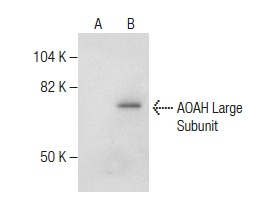
Western blot analysis of AOAH Large Subunit expression in non-transfected: (A) and human AOAH Large Subunit transfected: (B) 293T whole cell lysates.| Product Name | AOAH Large Subunit Antibody (H-300) |
|---|---|
| Antibody Type | Primary Antibodies |
| Antigen Alias | epitope corresponding to amino acids 276-575 mapping at the C-terminus of AOAH precursor protein of human origin |
| Modification Notes | AOAH (acyloxyacyl hydrolase) is a 575 amino acid protein that contains one saposin B-type domain. AOAH is cleaved into two chains, designated AOAH small subunit and AOAH large subunit, both of which contain many cysteine residues that may form disulfide bridges. Mature AOAH is a heterodimer that removes the secondary (acyloxyacyl-linked) fatty acyl chains from the lipid A region of bacterial endotoxins. AOAH is also thought to regulate host inflammatory responses to gram-negative bacterial invasion. The larger subunit of AOAH contains a Gly-X-Ser-X-Gly amino acid sequence that is found at the active site of many lipases, whereas the small subunit contains an amino acid sequence similar to saposins, which are cofactors for sphingolipid glycohydrolases. Both subunits are required in the proper orientation for specific catalytic activity toward LPS and glycerophosphatidylcholine. |
| Clonality | Polyclonal |
|---|---|
| Isotype | IgG |
| Host Species | Rabbit |
| Tested Applications | WBIPIFELISA |
| recommended for detection of AOAH large subunit of mouse, rat and human origin by WB, IP, IF and ELISA also reactive with additional species, including equine and canine: |
|
| Species Reactivity | HumanMouseRat |
| Concentration | 1mg/ml |
| Purification | Affinity purified |
| Alternative Names | epitope corresponding to amino acids 276-575 mapping at the C-terminus of AOAH precursor protein of human origin |
|---|---|
| Tissue Specificity | epitope corresponding to amino acids 276-575 mapping at the C-terminus of AOAH precursor protein of human origin |
| Entrez Gene | 313 |
|---|
Application
Western blot analysis of AOAH Large Subunit expression in non-transfected: (A) and human AOAH Large Subunit transfected: (B) 293T whole cell lysates.| Application Notes | recommended for detection of AOAH large subunit of mouse, rat and human origin by WB, IP, IF and ELISA also reactive with additional species, including equine and canine: |
|---|
| Form | Liquid |
|---|---|
| Storage Instructions | For short-term storage, store at 4° C. For long-term storage, aliquot and store at -20ºC or below. Avoid multiple freeze-thaw cycles. |
| Storage Buffer | phosphate buffered saline , pH 7.4, 150mM NaCl, 0.02% sodium azide and 50% glycerol. |


