Application
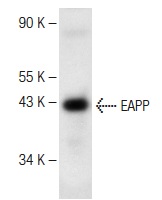
Western blot analysis of EAPP expression in MIA PaCa-2 whole cell lysate.| Product Name | EAPP Antibody (FL-285) |
|---|---|
| Antibody Type | Primary Antibodies |
| Antigen Alias | epitope corresponding to amino acids 1-285 representing full length EAPP of human origin |
| Modification Notes | E2F transcription factors play a major role in apoptosis and cell proliferation and are found to be frequently deregulated in cancers. Through interactions with cell cycle regulators such as cyclins, cyclin-dependent kinases and retinoblastoma protein (Rb), E2F family members also integrate cell cycle progression. EAPP (E2F-associated phosphoprotein) is a 285 amino acid highly phosphorylated nuclear protein that fine-tunes E2F activities by interacting with E2F-1, E2F-2 and E2F-3, but not E2F-4. By binding to the N-terminal domain of these E2F family members, EAPP interferes with the binding of cyclin A, Sp1 transcription factors, EBP1 and EBP2, therefore influencing E2F activity. Interestingly, EAPP is expressed during the cell cycle, but disappears during mitosis, suggesting that this step is necessary to complete the cell cycle. EAPP is ubiquitously expressed, with highest levels found in placenta, pancreas, skeletal muscle and heart. |
| Clonality | Polyclonal |
|---|---|
| Isotype | IgG |
| Host Species | Rabbit |
| Tested Applications | WBIPIFELISA |
| recommended for detection of EAPP of mouse, rat and human origin by WB, IP, IF and ELISA also reactive with additional species, including canine, bovine and porcine: |
|
| Species Reactivity | HumanMouseRat |
| Concentration | 1mg/ml |
| Purification | Affinity purified |
| Alternative Names | epitope corresponding to amino acids 1-285 representing full length EAPP of human origin |
|---|---|
| Tissue Specificity | epitope corresponding to amino acids 1-285 representing full length EAPP of human origin |
Application
Western blot analysis of EAPP expression in MIA PaCa-2 whole cell lysate.| Application Notes | recommended for detection of EAPP of mouse, rat and human origin by WB, IP, IF and ELISA also reactive with additional species, including canine, bovine and porcine: |
|---|
| Form | Liquid |
|---|---|
| Storage Instructions | For short-term storage, store at 4° C. For long-term storage, aliquot and store at -20ºC or below. Avoid multiple freeze-thaw cycles. |
| Storage Buffer | phosphate buffered saline , pH 7.4, 150mM NaCl, 0.02% sodium azide and 50% glycerol. |


