Application
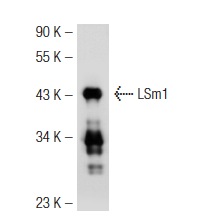
Western blot analysis of human recombinant LSm1 fusion protein.| Product Name | LSm1 Antibody (FL-133) |
|---|---|
| Antibody Type | Primary Antibodies |
| Antigen Alias | epitope corresponding to amino acids 1-133 representing full length LSm1 of human origin |
| Modification Notes | Sm and Sm-like (LSm) proteins form donut-shaped heptameric complexes that are involved in various steps of RNA metabolism. LSm proteins facilitate RNA protein interactions and structural changes that are required during ribosomal subunit assembly. LSm1, also designated U6 snRNA-associated Sm-like protein or small nuclear ribonuclear CaSm, binds specifically to the 3'-terminal U-tract of U6 snRNA. Human LSm1 localizes to the cytoplasm in small, discrete foci. These foci are also the localization site for the mRNA decapping enzyme Dcp1/2 and the exonuclease Xm1. LSm1 is naturally overexpressed in pancreatic cancer as well as in certain breast cancer cell lines. The downregulation of LSm1 is involved in the progression of prostate cancer. |
| Clonality | Polyclonal |
|---|---|
| Isotype | IgG |
| Host Species | Rabbit |
| Tested Applications | WBIPIFELISA |
| recommended for detection of LSm1 of mouse, rat and human origin by WB, IP, IF and ELISA also reactive with additional species, including equine, canine and bovine: |
|
| Species Reactivity | HumanMouseRat |
| Concentration | 1mg/ml |
| Purification | Affinity purified |
| Alternative Names | epitope corresponding to amino acids 1-133 representing full length LSm1 of human origin |
|---|---|
| Tissue Specificity | epitope corresponding to amino acids 1-133 representing full length LSm1 of human origin |
| Entrez Gene | 27257 |
|---|
Application
Western blot analysis of human recombinant LSm1 fusion protein.| Application Notes | recommended for detection of LSm1 of mouse, rat and human origin by WB, IP, IF and ELISA also reactive with additional species, including equine, canine and bovine: |
|---|
| Form | Liquid |
|---|---|
| Storage Instructions | For short-term storage, store at 4° C. For long-term storage, aliquot and store at -20ºC or below. Avoid multiple freeze-thaw cycles. |
| Storage Buffer | phosphate buffered saline , pH 7.4, 150mM NaCl, 0.02% sodium azide and 50% glycerol. |


