Application
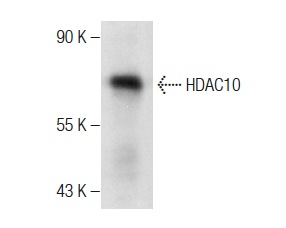
Western blot analysis of HDAC10 expression in mouse small intestine tissue extract.| Product Name | HDAC10 Antibody (H-56) |
|---|---|
| Antibody Type | Primary Antibodies |
| Antigen Alias | epitope corresponding to amino acids 61-116 mapping near the N-terminus of HDAC10 of human origin |
| Modification Notes | Histone deacetylases (HDACs) play an important role in the modification of chromatin structure and thus in the suppression and activation of transcription and cellular differentiation. There are 11 members in the HDAC family that are divided into four classes. Class I HDACs represent homologs of the yeast histone deacetylase Rpd3, class II HDACs share strong homology with the yeast histone deacetylase Hda1, class III HDACs are closely related to the yeast Sir2 protein and class IV HDACs comprise histone deacetylase 11 (HDAC11)-related enzymes. HDAC10, also known as HD10, is a member of the class II HDACs. It contains an N-terminal Hda1p-related catalytic domain and a unique C-terminal leucine-rich domain. HDAC10 is ubiquitously expressed and can shuttle between the cytoplasm and nucleus in response to celllular signals. It is able to repress transcription and, like other class II HDAC members, its enzymatic activity is inhibited by Trichostatin A (TSA). |
| Clonality | Polyclonal |
|---|---|
| Isotype | IgG |
| Host Species | Rabbit |
| Tested Applications | WBIPIFELISA |
| recommended for detection of histone deacetylase 10 of human and, to a lesser extent, mouse and rat origin by WB, IP, IF and ELISA also reactive with additional species, including equine: |
|
| Species Reactivity | HumanMouseRat |
| Concentration | 1mg/ml |
| Purification | Affinity purified |
| Alternative Names | epitope corresponding to amino acids 61-116 mapping near the N-terminus of HDAC10 of human origin |
|---|---|
| Tissue Specificity | epitope corresponding to amino acids 61-116 mapping near the N-terminus of HDAC10 of human origin |
| Entrez Gene | 83933 |
|---|
Application
Western blot analysis of HDAC10 expression in mouse small intestine tissue extract.| Application Notes | recommended for detection of histone deacetylase 10 of human and, to a lesser extent, mouse and rat origin by WB, IP, IF and ELISA also reactive with additional species, including equine: |
|---|
| Form | Liquid |
|---|---|
| Storage Instructions | For short-term storage, store at 4° C. For long-term storage, aliquot and store at -20ºC or below. Avoid multiple freeze-thaw cycles. |
| Storage Buffer | phosphate buffered saline , pH 7.4, 150mM NaCl, 0.02% sodium azide and 50% glycerol. |


