Application
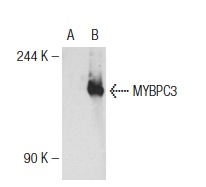
Western blot analysis of MYBPC3 expression in non-transfected: (A) and human MYBPC3 transfected: (B) 293T whole cell lysates.| Product Name | MYBPC3 Antibody (H-120) |
|---|---|
| Antibody Type | Primary Antibodies |
| Antigen Alias | epitope corresponding to amino acids 1-120 mapping at the N-terminus of MYBPC3 of human origin |
| Modification Notes | MYBPC3 (myosin-binding protein C, cardiac) encodes the cardiac isoform of the thick-filament myosin-binding protein C. It is found in the crossbridge-bearing zone (C region) of A bands in vertebrate striated muscle. Regulatory phosphorylation of MYBPC3 by cAMP-dependent protein kinase (PKA) upon adrenergic stimulation may be linked to modulation of cardiac contraction. MYBPC3 binds F-Actin, MHC and native thin filaments, and modifies the activity of Actin-activated myosin ATPase. Mutations in the MYBPC3 gene lead mainly to truncation of the protein, which results in one cause of familial hypertrophic cardiomyopathy type 4 (CMH4), a heart disorder characterized by ventricular hypertrophy, which often involves the interventricular septum and is usually asymmetric. The MYBPC3 gene maps to chromosome 11p11.2. |
| Clonality | Polyclonal |
|---|---|
| Isotype | IgG |
| Host Species | Rabbit |
| Tested Applications | WBIPIFELISA |
| recommended for detection of MYBPC3 (Myosin-binding protein C, cardiac-type) of human and, to a lesser extent, mouse and rat origin by WB, IP, IF and ELISA also reactive with additional species, including equine and porcine: |
|
| Species Reactivity | HumanMouseRat |
| Concentration | 1mg/ml |
| Purification | Affinity purified |
| Alternative Names | epitope corresponding to amino acids 1-120 mapping at the N-terminus of MYBPC3 of human origin |
|---|---|
| Tissue Specificity | epitope corresponding to amino acids 1-120 mapping at the N-terminus of MYBPC3 of human origin |
| Entrez Gene | 4607 |
|---|
Application
Western blot analysis of MYBPC3 expression in non-transfected: (A) and human MYBPC3 transfected: (B) 293T whole cell lysates.| Application Notes | recommended for detection of MYBPC3 (Myosin-binding protein C, cardiac-type) of human and, to a lesser extent, mouse and rat origin by WB, IP, IF and ELISA also reactive with additional species, including equine and porcine: |
|---|
| Form | Liquid |
|---|---|
| Storage Instructions | For short-term storage, store at 4° C. For long-term storage, aliquot and store at -20ºC or below. Avoid multiple freeze-thaw cycles. |
| Storage Buffer | phosphate buffered saline , pH 7.4, 150mM NaCl, 0.02% sodium azide and 50% glycerol. |


