Application
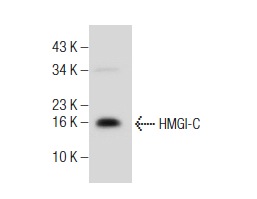
Western blot analysis of HMGI-C expression in NIH/3T3 whole cell lysate.Application
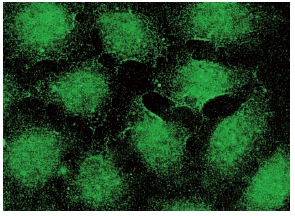
Immunofluorescence staining of methanol-fixed HeLa cells showing diffused nuclear localization.| Product Name | HMGI-C Antibody (FL-109) |
|---|---|
| Antibody Type | Primary Antibodies |
| Antigen Alias | epitope corresponding to amino acids 1-109 representing full length HMGI-C of human origin |
| Modification Notes | High mobility group (HMG) proteins 1 and 2 are ubiquitous non-histone components of chromatin. The binding of HMG proteins to the minor groove of AT-rich DNA sequences induces alterations in the DNA architecture, including DNA bending and unwinding of the helix. While HMG proteins do not stimulate initiation of transcription, they do enhance the binding of other transcription factors, such as Oct-2, members of the NFkB family, ATF-2 and c-Jun, to activate transcription. Human HMG-1 and HMG-2 contain two DNA-binding domains, termed HMG boxes. HMG proteins bind single-stranded and double-stranded DNA, but only induce conformational changes in double-stranded DNA. The gene encoding human HMGI-C, another HMG family member, maps to chromosome 12q15. Chromosomal translocations of the HMGI-C gene frequently appear in tumors of mesenchymal origin. Truncation of the HMGI-C gene leads to abnormal HMGI-C expression and transformation. Transgenic mice with HMGI-C truncation develop natural killer cell lymphomas and exhibit a giant phenotype. |
| Clonality | Polyclonal |
|---|---|
| Isotype | IgG |
| Host Species | Rabbit |
| Tested Applications | WBIPIFELISAGSChIP |
| recommended for detection of HMGI-C of mouse, rat and human origin by WB, IP, IF and ELISA may cross-react with HMG-I/HMG-Y also reactive with additional species, including porcine and avian: |
|
| Species Reactivity | HumanMouseRat |
| Concentration | 1mg/ml |
| Purification | Affinity purified |
| Alternative Names | epitope corresponding to amino acids 1-109 representing full length HMGI-C of human origin |
|---|---|
| Tissue Specificity | epitope corresponding to amino acids 1-109 representing full length HMGI-C of human origin |
| Entrez Gene | 8091 |
|---|
Application
Western blot analysis of HMGI-C expression in NIH/3T3 whole cell lysate.
Application
Immunofluorescence staining of methanol-fixed HeLa cells showing diffused nuclear localization.| Application Notes | recommended for detection of HMGI-C of mouse, rat and human origin by WB, IP, IF and ELISA may cross-react with HMG-I/HMG-Y also reactive with additional species, including porcine and avian: |
|---|
| Form | Liquid |
|---|---|
| Storage Instructions | For short-term storage, store at 4° C. For long-term storage, aliquot and store at -20ºC or below. Avoid multiple freeze-thaw cycles. |
| Storage Buffer | phosphate buffered saline , pH 7.4, 150mM NaCl, 0.02% sodium azide and 50% glycerol. |


