Application
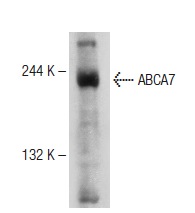
Western blot analysis of ABCA7 expression in human PBL whole cell lysate.| Product Name | ABCA7 Antibody (M-70) |
|---|---|
| Antibody Type | Primary Antibodies |
| Antigen Alias | epitope corresponding to amino acids 2031-2100 mapping near the C-terminus of ABCA7 of mouse origin |
| Modification Notes | ATP-binding cassette (ABC) transporters are an evolutionarily conserved family of widely-expressed proteins that use ATP hydrolysis to catalyze the transport of various molecules across extracellular and intracellular membranes. Eukaryotic ABC transporters are largely responsible for trafficking hydrophobic compounds either within the cell as part of a metabolic process, outside the cell for transport to other organs, or for secretion from the body. The cholesterol-responsive transporter, ABCA7, maps to human chromosome 19 and mouse chromosome 10 and has been reported as a candidate regulator of ceramide transport in epidermal lipid reorganization. High expression levels of ABCA7 have been reported in myelolymphatic tissues, reticuloendothelial cells, peripheral leukocytes, thymus, spleen and bone marrow. This expression pattern of the two alternatively-spliced isoforms also indicates an involvement in lipid homeostasis in cells of the immune system, though the complete role of ABCA7 is not yet known. Full-length type I ABCA7 has shown plasma membrane localization, while the type II splicing variant has shown expression predominantly in the endoplasmic reticulum. |
| Clonality | Polyclonal |
|---|---|
| Isotype | IgG |
| Host Species | Rabbit |
| Tested Applications | WBIPIFELISA |
| recommended for detection of ABCA7, isoforms a and b of mouse and rat origin by WB, IP, IF and ELISA: |
|
| Species Reactivity | HumanMouseRat |
| Concentration | 1mg/ml |
| Purification | Affinity purified |
| Alternative Names | epitope corresponding to amino acids 2031-2100 mapping near the C-terminus of ABCA7 of mouse origin |
|---|---|
| Tissue Specificity | epitope corresponding to amino acids 2031-2100 mapping near the C-terminus of ABCA7 of mouse origin |
| Entrez Gene | 27403 |
|---|
Application
Western blot analysis of ABCA7 expression in human PBL whole cell lysate.| Application Notes | recommended for detection of ABCA7, isoforms a and b of mouse and rat origin by WB, IP, IF and ELISA: |
|---|
| Form | Liquid |
|---|---|
| Storage Instructions | For short-term storage, store at 4° C. For long-term storage, aliquot and store at -20ºC or below. Avoid multiple freeze-thaw cycles. |
| Storage Buffer | phosphate buffered saline , pH 7.4, 150mM NaCl, 0.02% sodium azide and 50% glycerol. |


