Application
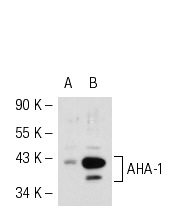
Western blot analysis of AHA-1 expression in non-transfected: (A) and mouse AHA-1 transfected: (B) 293T whole cell lysates.| Product Name | AHA-1 Antibody (H-90) |
|---|---|
| Antibody Type | Primary Antibodies |
| Antigen Alias | epitope corresponding to amino acids 249-338 mapping at the C-terminus of AHA-1 of human origin |
| Modification Notes | AHA-1 stimulates the inherent ATPase activity of yeast and human HSP 90 and interacts with the cytoplasmic tail of vesticular stomatitis virus glycoprotein. AHA-1 regulates HSP 90 by influencing the conformational state of the “ATP lid” and consequent N-terminal dimerization. It is crucial for cell viability under non-optimal growth conditions when HSP 90 levels are limiting. AHA-1 is a cytosolic protein and may transiently interact with the endoplasmic reticulum. It can have an affect on one step in the endoplasmic to Golgi trafficking. AHA-1 is expressed in numerous tissues, including brain, heart, skeletal muscle and kidney and, at lower levels, in liver and placenta. It is induced by heat shock and treatment with the HSP 90 inhibitor 17-demeth-oxygeldanamycin. |
| Clonality | Polyclonal |
|---|---|
| Isotype | IgG |
| Host Species | Rabbit |
| Tested Applications | WBIPIFELISA |
| recommended for detection of AHA-1 of mouse, rat and human origin by WB, IP, IF and ELISA also reactive with additional species, including equine, canine, bovine and porcine: |
|
| Species Reactivity | HumanMouseRat |
| Concentration | 1mg/ml |
| Purification | Affinity purified |
| Alternative Names | epitope corresponding to amino acids 249-338 mapping at the C-terminus of AHA-1 of human origin |
|---|---|
| Tissue Specificity | epitope corresponding to amino acids 249-338 mapping at the C-terminus of AHA-1 of human origin |
| Entrez Gene | 10598 |
|---|
Application
Western blot analysis of AHA-1 expression in non-transfected: (A) and mouse AHA-1 transfected: (B) 293T whole cell lysates.| Application Notes | recommended for detection of AHA-1 of mouse, rat and human origin by WB, IP, IF and ELISA also reactive with additional species, including equine, canine, bovine and porcine: |
|---|
| Form | Liquid |
|---|---|
| Storage Instructions | For short-term storage, store at 4° C. For long-term storage, aliquot and store at -20ºC or below. Avoid multiple freeze-thaw cycles. |
| Storage Buffer | phosphate buffered saline , pH 7.4, 150mM NaCl, 0.02% sodium azide and 50% glycerol. |


