Application
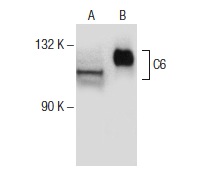
Western blot analysis of C6 expression in non-transfected (A) and human C6 transfected (B) whole cell lysates.| Product Name | C6 Antibody (M-126) |
|---|---|
| Antibody Type | Primary Antibodies |
| Antigen Alias | raised against amino acids 175-300 mapping within an internal region of C6 of mouse origin |
| Modification Notes | The complement cascade is a multi-protein system that functions to clear pathogens from an infected host. Part of the innate (unchanging) immune system, the complement cascade consists of proteins and inactive zymogens that are present in blood and are stimulated by one of several triggers. Once stimulated, the cascade relays amplified responses throughout the body, ultimately activating the cell-killing membrane attack complex which can insert itself into the cell membrane and cause the cell to lyse. C6 (Complement component C6) is a 934 amino acid secreted protein that plays a role in the complement cascade, specifically functioning as part of the membrane attack complex. Expressed as two transcript variants, C6 contains one EGF-like domain, one LDL-receptor class A domain, one MACPF domain, two Sushi domains and three TSP type-1 domains. C6 deficiency is correlated with a higher risk of bacterial infection, further supporting the importance of C6 in the innate immune system. |
| Clonality | Polyclonal |
|---|---|
| Isotype | IgG |
| Host Species | Rabbit |
| Tested Applications | WBIPIFELISA |
| recommended for detection of C6 of mouse and rat origin by WB, IP, IF and ELISA: |
|
| Species Reactivity | HumanMouseRat |
| Concentration | 1mg/ml |
| Purification | Affinity purified |
| Alternative Names | raised against amino acids 175-300 mapping within an internal region of C6 of mouse origin |
|---|---|
| Tissue Specificity | raised against amino acids 175-300 mapping within an internal region of C6 of mouse origin |
| Entrez Gene | 12274 |
|---|
Application
Western blot analysis of C6 expression in non-transfected (A) and human C6 transfected (B) whole cell lysates.| Application Notes | recommended for detection of C6 of mouse and rat origin by WB, IP, IF and ELISA: |
|---|
| Form | Liquid |
|---|---|
| Storage Instructions | For short-term storage, store at 4° C. For long-term storage, aliquot and store at -20ºC or below. Avoid multiple freeze-thaw cycles. |
| Storage Buffer | phosphate buffered saline , pH 7.4, 150mM NaCl, 0.02% sodium azide and 50% glycerol. |


