Application
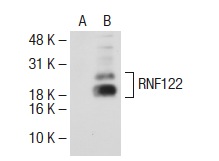
Western blot analysis of RNF122 expression in non-transfected: (A) and mouse RNF122 transfected: (B) 293T whole cell lysates.| Product Name | RNF122 Antibody (G-13) |
|---|---|
| Antibody Type | Primary Antibodies |
| Antigen Alias | epitope mapping within an internal region of RNF122 of human origin |
| Modification Notes | The RING-type zinc finger motif is present in a number of viral and eukaryotic proteins and is made of a conserved cysteine-rich domain that is able to bind two zinc atoms. Proteins that contain this conserved domain are generally involved in the ubiquitination pathway of protein degradation. RNF122 (ring finger protein 122) is a 155 amino acid single-pass membrane protein protein that contains one RING-type zinc finger and localizes to the Golgi apparatus and endoplasmic reticulum. WIdely expressed, RNF122 is believed to induce apoptosis and necrosis, and may influence cell viability. The gene encoding RNF122 maps to human chromosome 8, which consists of nearly 146 million base pairs, encodes over 800 genes and is associated with a variety of diseases and malignancies. Schizophrenia, bipolar disorder, Trisomy 8, Pfeiffer syndrome, congenital hypothyroidism, Waardenburg syndrome and some leukemias and lymphomas are thought to occur as a result of defects in specific genes that map to chromosome 8. |
| Clonality | Polyclonal |
|---|---|
| Isotype | IgG |
| Host Species | Rabbit |
| Tested Applications | WBIPIFELISA |
| recommended for detection of RNF122 of mouse, rat and human origin by WB, IP, IF and ELISA also reactive with additional species, including equine, canine, bovine and porcine: |
|
| Species Reactivity | HumanMouseRat |
| Concentration | 1mg/ml |
| Purification | Affinity purified |
| Alternative Names | epitope mapping within an internal region of RNF122 of human origin |
|---|---|
| Tissue Specificity | epitope mapping within an internal region of RNF122 of human origin |
| Entrez Gene | 79845 |
|---|
Application
Western blot analysis of RNF122 expression in non-transfected: (A) and mouse RNF122 transfected: (B) 293T whole cell lysates.| Application Notes | recommended for detection of RNF122 of mouse, rat and human origin by WB, IP, IF and ELISA also reactive with additional species, including equine, canine, bovine and porcine: |
|---|
| Form | Liquid |
|---|---|
| Storage Instructions | For short-term storage, store at 4° C. For long-term storage, aliquot and store at -20ºC or below. Avoid multiple freeze-thaw cycles. |
| Storage Buffer | phosphate buffered saline , pH 7.4, 150mM NaCl, 0.02% sodium azide and 50% glycerol. |


