Application
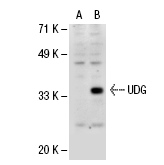
Western blot analysis of UDG expression in non-transfected: (A) and human UDG transfected: (B) 293 whole cell lysate.| Product Name | UDG Antibody (FL-313) |
|---|---|
| Antibody Type | Primary Antibodies |
| Antigen Alias | epitope corresponding to amino acids 67-313 mapping at the C-terminus of UDG of human origin |
| Modification Notes | When misincorporation or cytosine deamination positions the RNA nucleotide uracil into DNA, uracil-DNA gycosylase (UDG) excises the uracil via a repair enzymatic pathway. This is done by cleaving the N-C1' gylcosylic bond between the base and deoxyribose, in both single and double-stranded DNA. While initiating the first steps of DNA repair, UDG undergoes a conformational change from the “open” unbound state to the “closed” DNA-bound state, creating a catalytic center. The bound UDG effectively flips the uridine nucleotide into the catalyic center and cleaves the glycosylic bond to excise the uracil. The open-to-closed conformation change is centered on a B zipper in the UDG. UDG alters the orientation electron orbitals to favor electron transpositions, thus taking advantage of conformational strain to catapult the cleavage of the gylcosylic bond. Two isoforms of UDG, UDG1 and UDG1A, have been characterized. The UDG1 isoform localizes to the mitochondria. UDG1A is a processed isoform containing a unique 44 residue amino-terminus which localizes this isoform to the nucleus. |
| Clonality | Polyclonal |
|---|---|
| Isotype | IgG |
| Host Species | Rabbit |
| Tested Applications | WBIPIFELISA |
| recommended for detection of UDG isoforms 1 and 2 of mouse, rat and human origin by WB, IP, IF and ELISA also reactive with additional species, including porcine: |
|
| Species Reactivity | HumanMouseRat |
| Concentration | 1mg/ml |
| Purification | Affinity purified |
| Alternative Names | epitope corresponding to amino acids 67-313 mapping at the C-terminus of UDG of human origin |
|---|---|
| Tissue Specificity | epitope corresponding to amino acids 67-313 mapping at the C-terminus of UDG of human origin |
| Entrez Gene | 7374 |
|---|
Application
Western blot analysis of UDG expression in non-transfected: (A) and human UDG transfected: (B) 293 whole cell lysate.| Application Notes | recommended for detection of UDG isoforms 1 and 2 of mouse, rat and human origin by WB, IP, IF and ELISA also reactive with additional species, including porcine: |
|---|
| Form | Liquid |
|---|---|
| Storage Instructions | For short-term storage, store at 4° C. For long-term storage, aliquot and store at -20ºC or below. Avoid multiple freeze-thaw cycles. |
| Storage Buffer | phosphate buffered saline , pH 7.4, 150mM NaCl, 0.02% sodium azide and 50% glycerol. |


