Application
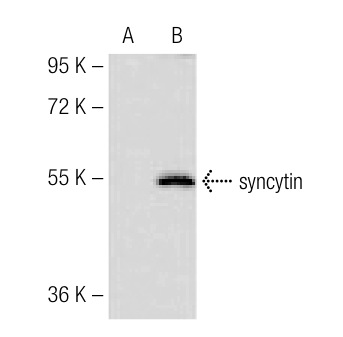
Western blot analysis of syncytin expression in non-transfected (A) and human syncytin transfected (B) 293 whole cell lysates.| Product Name | syncytin Antibody (Z-25) |
|---|---|
| Antibody Type | Primary Antibodies |
| Antigen Alias | recommended for detection of syncytin of human origin by WB, IP and ELISA |
| Modification Notes | Syncytin, also known as ERVWE1 (endogenous retroviral family W, env(C7), member 1) is a human endogenous retrovirus family W (HERV-W) envelope protein that is expressed in placental syncytiotrophoblast and is involved in fusion of the cytotrophoblast cells to form the multinucleated syncytial layer of the placenta. Syncytin is an envelope protein after in vitro transcription-translation and undergoes glycosylation. It is predicted to undergo post-translational cleavage into a surface (SU) subunit and a transmembrane (TM) subunit. Syncytin is similar to other retroviral envelope proteins in possessing a furin cleavage site that separates the surface (SU) and transmembrane (TM) proteins, which form a heterodimer. Northern blot analysis has been shown to detect 8.0-, 3.1-, and 1.3-kb HERV-W transcripts only in placenta. Syncytin expression can increase three-fold in astrocytes and glial cells within acute demyelinating lesions of patients with multiple sclerosis compared to controls. |
| Clonality | Polyclonal |
|---|---|
| Isotype | IgG |
| Host Species | Rabbit |
| Tested Applications | WBIPELISA |
| WB:1:500~1:2000 IP:1:100~1:500 Notes:Optimal dilutions/concentrations should be determined by the researcher. |
|
| Species Reactivity | HumanMouseRat |
| Concentration | 1mg/ml |
| Purification | Affinity purified |
| Alternative Names | recommended for detection of syncytin of human origin by WB IP and ELISA |
|---|---|
| Tissue Specificity | recommended for detection of syncytin of human origin by WB, IP and ELISA |
| Entrez Gene | 30816 |
|---|
Application
Western blot analysis of syncytin expression in non-transfected (A) and human syncytin transfected (B) 293 whole cell lysates.| Application Notes | WB:1:500~1:2000 IP:1:100~1:500 Notes:Optimal dilutions/concentrations should be determined by the researcher. |
|---|
| Form | Liquid |
|---|---|
| Storage Instructions | For short-term storage, store at 4° C. For long-term storage, aliquot and store at -20ºC or below. Avoid multiple freeze-thaw cycles. |
| Storage Buffer | phosphate buffered saline , pH 7.4, 150mM NaCl, 0.02% sodium azide and 50% glycerol. |


