Application
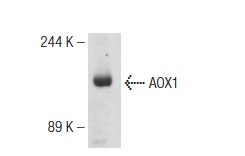
Western blot analysis of AOX1 expression in rat liver tissue extract.| Product Name | AOX1 Antibody (H-64) |
|---|---|
| Antibody Type | Primary Antibodies |
| Antigen Alias | epitope corresponding to amino acids 854-917 mapping within an internal region of AOX1 of human origin |
| Modification Notes | The formation of free radicals is an adverse consequence of metabolism. Free radicals endanger cells by causing oxidative damage to membranes and can lead to interruption of DNA sequences, thereby potentially resulting in carcinogenesis. As a member of the molybdo-flavoenzymes family of proteins, AOX1 (Aldehyde oxidase 1) is a 1338 amino acid cytoplasmic protein that catalyzes the oxidation of a variety of aldehydes, leading to the production of hydrogen peroxide. Under certain conditions, AOX1 can catalyze the formation of the superoxide free radical. Defects in oxygen radical metabolism have been linked to the pathogenesis of amyotrophic lateral sclerosis (ALS), an autosomal dominant neurodegenerative disorder characterized by the death of motor neurons in the spinal cord, brain and brainstem. Significantly, AOX1 is highly expressed in the ventral horn of the spinal cord and the gene that encodes AOX1 is located in a chromosomal region that is frequently found to be implicated in ALS2. This evidence suggests that AOX1 is a candidate gene for ALS2. |
| Clonality | Polyclonal |
|---|---|
| Isotype | IgG |
| Host Species | Rabbit |
| Tested Applications | WBIPIFELISA |
| recommended for detection of AOX1 of mouse, rat and human origin by WB, IP, IF and ELISA also reactive with additional species, including bovine and porcine: |
|
| Species Reactivity | HumanMouseRat |
| Concentration | 1mg/ml |
| Purification | Affinity purified |
| Alternative Names | epitope corresponding to amino acids 854-917 mapping within an internal region of AOX1 of human origin |
|---|---|
| Tissue Specificity | epitope corresponding to amino acids 854-917 mapping within an internal region of AOX1 of human origin |
| Entrez Gene | 316 |
|---|
Application
Western blot analysis of AOX1 expression in rat liver tissue extract.| Application Notes | recommended for detection of AOX1 of mouse, rat and human origin by WB, IP, IF and ELISA also reactive with additional species, including bovine and porcine: |
|---|
| Form | Liquid |
|---|---|
| Storage Instructions | For short-term storage, store at 4° C. For long-term storage, aliquot and store at -20ºC or below. Avoid multiple freeze-thaw cycles. |
| Storage Buffer | phosphate buffered saline , pH 7.4, 150mM NaCl, 0.02% sodium azide and 50% glycerol. |


