Application
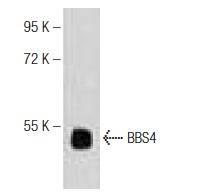
Western blot analysis of BBS4 expression in HeLa whole cell lysate.| Product Name | BBS4 Antibody (F-24) |
|---|---|
| Antibody Type | Primary Antibodies |
| Antigen Alias | recommended for detection of BBS4 of human origin by WB, IP and ELISA |
| Modification Notes | Bardet-Biedl syndrome (BBS) is a pleiotropic genetic disorder characterized by obesity, photoreceptor degeneration, polydactyly, hypogenitalism, renal abnormalities, and developmental delay. Other associated clinical findings in BBS patients include diabetes, hypertension, and congenital heart defects. BBS is a heterogeneous disorder; BBS genes map to eight genetic loci and encode eight proteins, BBS1-BBS8. Five BBS genes encode basal body or cilia proteins, suggesting that BBS is a ciliary dysfunction disorder. BBS4 is expressed in the olfactory epithelium and localizes to the centriolar satellites of centrosomes and basal bodies of primary cilia. BBS4 regulates the p150 subunit of the dynein transport machinery (DCTN1) to attract pericentriolar material-1 protein (PCM1) and its associated components to the satellites. Loss of BBS4 is correlated with obesity caused by abnormal lipid profiles, liver dysfunction, elevated insulin, and abnormal leptin levels. |
| Clonality | Polyclonal |
|---|---|
| Isotype | IgG |
| Host Species | Rabbit |
| Tested Applications | WBIPELISA |
| WB:1:500~1:2000 IP:1:100~1:500 Notes:Optimal dilutions/concentrations should be determined by the researcher. |
|
| Species Reactivity | HumanMouseRat |
| Concentration | 1mg/ml |
| Purification | Affinity purified |
| Alternative Names | recommended for detection of BBS4 of human origin by WB IP and ELISA |
|---|---|
| Tissue Specificity | recommended for detection of BBS4 of human origin by WB, IP and ELISA |
| Entrez Gene | 585 |
|---|
Application
Western blot analysis of BBS4 expression in HeLa whole cell lysate.| Application Notes | WB:1:500~1:2000 IP:1:100~1:500 Notes:Optimal dilutions/concentrations should be determined by the researcher. |
|---|
| Form | Liquid |
|---|---|
| Storage Instructions | For short-term storage, store at 4° C. For long-term storage, aliquot and store at -20ºC or below. Avoid multiple freeze-thaw cycles. |
| Storage Buffer | phosphate buffered saline , pH 7.4, 150mM NaCl, 0.02% sodium azide and 50% glycerol. |


