Application
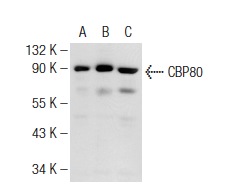
Western blot analysis of CBP80 expression in non-transfected 293T: (A), human CBP80 transfected 293T: (B) and Jurkat (C) whole cell lysates.| Product Name | CBP80 Antibody (H-300) |
|---|---|
| Antibody Type | Primary Antibodies |
| Antigen Alias | epitope corresponding to amino acids 21-320 mapping at the N-terminus of CBP80 of human origin |
| Modification Notes | In eukaryotes, the majority of mRNAs have an m(7)G cap, which is added cotranscriptionally and plays a critical role in many aspects of mRNA metabolism. The effect of the cap on translation is mediated by the initiation factor eIF-4F, whereas the effect on pre-mRNA splicing involves a nuclear complex (CBC). CBC consists of two cap binding proteins CBP20 and CBP80, which mediate the stimulatory functions of the cap in pre-mRNA splicing, 3' end formation and U snRNA export (1–3). The genes CBC1 and CBC2 encode CBP80 and CBP20, respectively (4) CBP80 comprises three domains, each containing a MIF4G domain. CBP20 has an RNAP fold and associates with the second and third domains of CBP80 (5). CBP also plays a role in nonsense-mediated decay (NMD), which eliminates mRNAs, which prematurely terminate translation. CBP80-bound mRNA undergoes a “pioneer” round of translation before CBP80-CBP20 are replaced by eIF4E, and Upf2 and Upf3 proteins (6). |
| Clonality | Polyclonal |
|---|---|
| Isotype | IgG |
| Host Species | Rabbit |
| Tested Applications | WBIPIFELISAGSChIP |
| recommended for detection of CBP80 of mouse, rat and human origin by WB, IP, IF and ELISA also reactive with additional species, including equine, canine, bovine and avian: |
|
| Species Reactivity | HumanMouseRat |
| Concentration | 1mg/ml |
| Purification | Affinity purified |
| Alternative Names | epitope corresponding to amino acids 21-320 mapping at the N-terminus of CBP80 of human origin |
|---|---|
| Tissue Specificity | epitope corresponding to amino acids 21-320 mapping at the N-terminus of CBP80 of human origin |
| Entrez Gene | 4686 |
|---|
Application
Western blot analysis of CBP80 expression in non-transfected 293T: (A), human CBP80 transfected 293T: (B) and Jurkat (C) whole cell lysates.| Application Notes | recommended for detection of CBP80 of mouse, rat and human origin by WB, IP, IF and ELISA also reactive with additional species, including equine, canine, bovine and avian: |
|---|
| Form | Liquid |
|---|---|
| Storage Instructions | For short-term storage, store at 4° C. For long-term storage, aliquot and store at -20ºC or below. Avoid multiple freeze-thaw cycles. |
| Storage Buffer | phosphate buffered saline , pH 7.4, 150mM NaCl, 0.02% sodium azide and 50% glycerol. |


