Application
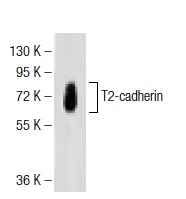
Western blot analysis of T2-cadherin expression in NCI-H460 whole cell lysate.| Product Name | T2-cadherin Antibody (A-23) |
|---|---|
| Antibody Type | Primary Antibodies |
| Antigen Alias | recommended for detection of T2-cadherin of human origin by WB, IF, IHC(P) and ELISA |
| Modification Notes | The cadherins are a family of Ca2+-dependent adhesion molecules that function to mediate cell-cell binding critical to the maintenance of structure and morphogenesis. Cadherins each contain a large extracellular domain at the N-terminus, which is characterized by a series of five homologous repeats, the most distal of which is thought to be responsible for binding specificity. T2-cadherin, also known as cadherin-10 or CDH10, is a 788 amino acid single-pass type I membrane protein that belongs to the cadherin family and contains five cadherin domains. Expressed predominately in brain, but also found in prostate and both adult and fetal kidney, T2-cadherin functions as a calcium-dependent cell adhesion protein that is thought to be involved in the maintenance of synaptic adhesions, axon outgrowth and guidance. |
| Clonality | Polyclonal |
|---|---|
| Isotype | IgG |
| Host Species | Rabbit |
| Tested Applications | WBIFIHCELISA |
| WB:1:500~1:2000 IF:1:200~1:500 IHC:1:50~1:200 Notes:Optimal dilutions/concentrations should be determined by the researcher. |
|
| Species Reactivity | HumanMouseRat |
| Concentration | 1mg/ml |
| Purification | Affinity purified |
| Alternative Names | recommended for detection of T2-cadherin of human origin by WB IF IHC(P) and ELISA |
|---|---|
| Tissue Specificity | recommended for detection of T2-cadherin of human origin by WB, IF, IHC(P) and ELISA |
| Entrez Gene | 1008 |
|---|
Application
Western blot analysis of T2-cadherin expression in NCI-H460 whole cell lysate.| Application Notes | WB:1:500~1:2000 IF:1:200~1:500 IHC:1:50~1:200 Notes:Optimal dilutions/concentrations should be determined by the researcher. |
|---|
| Form | Liquid |
|---|---|
| Storage Instructions | For short-term storage, store at 4° C. For long-term storage, aliquot and store at -20ºC or below. Avoid multiple freeze-thaw cycles. |
| Storage Buffer | phosphate buffered saline , pH 7.4, 150mM NaCl, 0.02% sodium azide and 50% glycerol. |


