Application
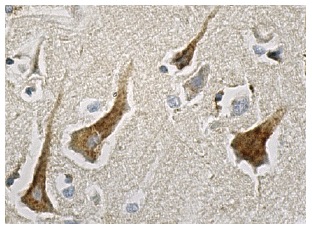
Immunoperoxidase staining of formalin fixed, paraffin-embedded human brain tissue showing cytoplasmic staining of neuronal cells.Application
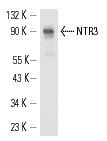
Western blot analysis of NTR3 expression in MIA PaCa-2 whole cell lysate.| Product Name | NTR3 Antibody (H-300) |
|---|---|
| Antibody Type | Primary Antibodies |
| Antigen Alias | epitope corresponding to amino acids 78-377 mapping within an extracellular domain of NTR3 of human origin |
| Modification Notes | Neurotensin (NT) initiates an intracellular response by interacting with the G protein-coupled receptors NTR1 (NTS1 receptor, high affinity NTR) and NTR2 (NTS2 receptor, levocabastine-sensitive neurotensin receptor), and the type I receptor NTR3 (NTS3 receptor, sortilin-1, Gp95). NT has a wide distribution in regions of the brain and in peripheral tissues where NT receptors can contribute to hypotension, hyperglycemia, hypothermia, antinociception and regulation of intestinal motility and secretion. HL-60 cells express NTR1, which can couple to Gq, Gi/o, or Gs. Alternative splicing of rat NTR2 can generate a 5-transmembrane domain variant isoform that is co-expressed with the full-length NTR2 throughout the brain and spinal cord. NTR3 activation in the murine microglial cell line N11 induces MIP-2, MCP-1, IL-1∫ and TNFå in an ERK1/2 and Akt kinase-dependent manner. |
| Clonality | Polyclonal |
|---|---|
| Isotype | IgG |
| Host Species | Rabbit |
| Tested Applications | WBIPIFIHCELISA |
| recommended for detection of NTR3 of mouse, rat and human origin by WB, IP, IF, IHC(P) and ELISA also reactive with additional species, including bovine, canine and porcine: |
|
| Species Reactivity | HumanMouseRat |
| Concentration | 1mg/ml |
| Purification | Affinity purified |
| Alternative Names | epitope corresponding to amino acids 78-377 mapping within an extracellular domain of NTR3 of human origin |
|---|---|
| Tissue Specificity | epitope corresponding to amino acids 78-377 mapping within an extracellular domain of NTR3 of human origin |
| Entrez Gene | 6272 |
|---|
Application
Immunoperoxidase staining of formalin fixed, paraffin-embedded human brain tissue showing cytoplasmic staining of neuronal cells.
Application
Western blot analysis of NTR3 expression in MIA PaCa-2 whole cell lysate.| Application Notes | recommended for detection of NTR3 of mouse, rat and human origin by WB, IP, IF, IHC(P) and ELISA also reactive with additional species, including bovine, canine and porcine: |
|---|
| Form | Liquid |
|---|---|
| Storage Instructions | For short-term storage, store at 4° C. For long-term storage, aliquot and store at -20ºC or below. Avoid multiple freeze-thaw cycles. |
| Storage Buffer | phosphate buffered saline , pH 7.4, 150mM NaCl, 0.02% sodium azide and 50% glycerol. |


