Application
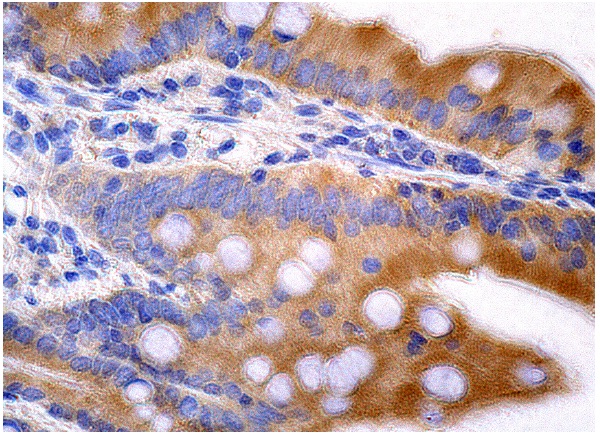
Immunoperoxidase staining of formalin fixed, paraffin-embedded human duodenum tissue showing cytoplasmic staining of glandular cells.| Product Name | Laminin α-3 Antibody (H-187) |
|---|---|
| Antibody Type | Primary Antibodies |
| Antigen Alias | raised against amino acids 3034-3220 mapping near the C-terminus of Laminin α-3 of human origin |
| Modification Notes | Laminins are essential and abundant structural non-collagenous glyco-proteins localizing to basement membranes. Basement membranes (cell-associated extracellular matrices (ECMs)) are polymers of laminins with stabilizing type IV collagen networks, nidogen and several proteoglycans, found under epithelial layers, around the endothelium of blood vessels, and surrounding muscle, peripheral nerve, and fat cells. Formation of basement membranes influences cell proliferation, phenotype, migration, gene expression, and tissue architecture. Each laminin is a heterotrimer of a, b, and g chain subunits that undergoes cell-secretion and incorporation into the ECM. Laminins can self-assemble, bind to other matrix macromolecules, and have unique and shared cell interactions mediated by integrins, dystroglycan, and cognate laminin receptors. The human laminin a-3 gene maps to chromosome 18q11.2 and encodes the alpha subunit of Laminin-5, which influences cell adhesion, signal transduction and differentiation of keratinocytes. |
| Clonality | Polyclonal |
|---|---|
| Isotype | IgG |
| Host Species | Rabbit |
| Tested Applications | WBIPIFIHCELISA |
| recommended for detection of Laminin α-3 of mouse, rat and human origin by WB, IP, IF, IHC(P) and ELISA also reactive with additional species, including porcine: |
|
| Species Reactivity | HumanMouseRat |
| Concentration | 1mg/ml |
| Purification | Affinity purified |
| Alternative Names | raised against amino acids 3034-3220 mapping near the C-terminus of Laminin &alpha -3 of human origin |
|---|---|
| Tissue Specificity | raised against amino acids 3034-3220 mapping near the C-terminus of Laminin α-3 of human origin |
| Entrez Gene | 3909 |
|---|
Application
Immunoperoxidase staining of formalin fixed, paraffin-embedded human duodenum tissue showing cytoplasmic staining of glandular cells.| Application Notes | recommended for detection of Laminin α-3 of mouse, rat and human origin by WB, IP, IF, IHC(P) and ELISA also reactive with additional species, including porcine: |
|---|
| Form | Liquid |
|---|---|
| Storage Instructions | For short-term storage, store at 4° C. For long-term storage, aliquot and store at -20ºC or below. Avoid multiple freeze-thaw cycles. |
| Storage Buffer | phosphate buffered saline , pH 7.4, 150mM NaCl, 0.02% sodium azide and 50% glycerol. |


