Application
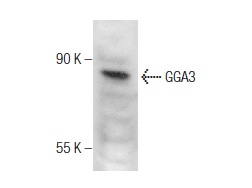
Western blot analysis of GGA3 expression in Jurkat whole cell lysate.| Product Name | GGA3 Antibody (H-300) |
|---|---|
| Antibody Type | Primary Antibodies |
| Antigen Alias | epitope corresponding to amino acids 281-580 mapping within an internal region of GGA3 of human origin |
| Modification Notes | The GGA family of proteins (Golgi-localized, g-Adaptin ear-containing, ARF-binding proteins) are ubiquitous coat proteins that facilitate the trafficking of soluble proteins from the trans-Golgi network (TGN) to endosomes/lysosomes by means of interactions with TGN-sorting receptors, ARF (ADP-ribosylation factor), and clathrin. Members of the GGA family, GGA1,GGA2 (also known as VEAR) and GGA3, are multi-domain proteins that bind mannose 6-phosphate receptors (MPRs). GGAs have modular structures with an N-terminal VHS (VPS27, Hrs and STAM) domain followed by a GAT (GGA and Tom1) domain, a connecting hinge segment and a C-terminal GAE (g-Adaptin ear) domain. The amino-terminal VHS domains of GGAs form complexes with the cytoplasmic domains of sorting receptors by recognizing acidic-cluster di-leucine (ACLL) sequences. The human GGA3 gene maps to chromosome 17 and encodes a 723 amino acid protein that shares 46% sequence identity with GGA1 and 38% with GGA2. |
| Clonality | Polyclonal |
|---|---|
| Isotype | IgG |
| Host Species | Rabbit |
| Tested Applications | WBIPIFELISA |
| recommended for detection of GGA3 of mouse, rat and human origin by WB, IP, IF and ELISA: |
|
| Species Reactivity | HumanMouseRat |
| Concentration | 1mg/ml |
| Purification | Affinity purified |
| Alternative Names | epitope corresponding to amino acids 281-580 mapping within an internal region of GGA3 of human origin |
|---|---|
| Tissue Specificity | epitope corresponding to amino acids 281-580 mapping within an internal region of GGA3 of human origin |
| Entrez Gene | 23163 |
|---|
Application
Western blot analysis of GGA3 expression in Jurkat whole cell lysate.| Application Notes | recommended for detection of GGA3 of mouse, rat and human origin by WB, IP, IF and ELISA: |
|---|
| Form | Liquid |
|---|---|
| Storage Instructions | For short-term storage, store at 4° C. For long-term storage, aliquot and store at -20ºC or below. Avoid multiple freeze-thaw cycles. |
| Storage Buffer | phosphate buffered saline , pH 7.4, 150mM NaCl, 0.02% sodium azide and 50% glycerol. |


