Application
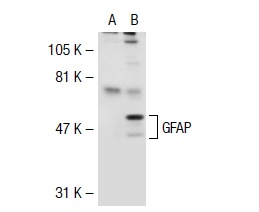
Western blot analysis of GFAP phosphorylation in non-transfected: (A) and human GFAP transfected: (B) 293T whole cell lysates.| Product Name | p-GFAP Antibody (Ser 13) |
|---|---|
| Antibody Type | Primary Antibodies |
| Antigen Alias | epitope corresponding to phosphorylated Ser 13 of GFAP of human origin |
| Modification | Phosphoralated |
| Modification Notes | Glial fibrillary acidic protein, or GFAP, is an intermediate filament (IF) protein belonging to the type III subclass of IF proteins. Like other IF proteins, GFAP is composed of an amino terminal head domain, a central rod domain and a carboxy terminal tail domain. GFAP is specifically found in astroglia, a cell type which is highly responsive to neurologic insults. Astrogliosis is found to be a result of mechanical trauma, AIDS dementia, prion infection and inflammatory demylination diseases, and is accompanied by an increase in GFAP expression. GFAP is an immunohistochemical marker for localizing benign astrocyte and neoplastic cells of glial origin in the central nervous system. In cytokinesis, the p-Ser 8 residues become dephosphorylated, whereas Thr 7, Ser 13 (Ser 12 in mouse) and Ser 34 in glial filaments at the cleavage furrow become the preferred sites of phosphorylation. |
| Clonality | Polyclonal |
|---|---|
| Isotype | IgG |
| Host Species | Rabbit |
| Tested Applications | WBIPIFELISA |
| recommended for detection of Ser 13 phosphorylated GFAP of human origin by WB, IP, IF and ELISA also reactive with additional species, including equine and porcine: |
|
| Species Reactivity | HumanMouseRat |
| Concentration | 1mg/ml |
| Purification | Affinity purified |
| Alternative Names | epitope corresponding to phosphorylated Ser 13 of GFAP of human origin |
|---|---|
| Tissue Specificity | epitope corresponding to phosphorylated Ser 13 of GFAP of human origin |
| Entrez Gene | 2670 |
|---|
Application
Western blot analysis of GFAP phosphorylation in non-transfected: (A) and human GFAP transfected: (B) 293T whole cell lysates.| Application Notes | recommended for detection of Ser 13 phosphorylated GFAP of human origin by WB, IP, IF and ELISA also reactive with additional species, including equine and porcine: |
|---|
| Form | Liquid |
|---|---|
| Storage Instructions | For short-term storage, store at 4° C. For long-term storage, aliquot and store at -20ºC or below. Avoid multiple freeze-thaw cycles. |
| Storage Buffer | phosphate buffered saline , pH 7.4, 150mM NaCl, 0.02% sodium azide and 50% glycerol. |


