Application
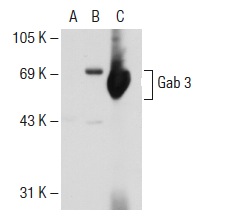
Western blot analysis of Gab 3 expression in non-transfected: (A) and human Gab 3 transfected: (B) 293T whole cell lysates and rat spleen tissue extract (C).| Product Name | Gab 3 Antibody (H-300) |
|---|---|
| Antibody Type | Primary Antibodies |
| Antigen Alias | epitope corresponding to amino acids 101-400 mapping within an internal region of Gab 3 of human origin |
| Modification Notes | The Gab (GRB2-associated binder)/DOS ('Daughter of Sevenless') (Gab) family of adaptor proteins function as molecular scaffolds that mediate protein recrutiment to RTKs (1–3). Cytokine/growth factor triggering of protein tyrosine kinase receptors (RTKs) initiates signaling cascades that progress to the nucleus where signals for activation, proliferation and differentiation occur (1–3). This scaffolding mechanism represents a critical link in cytokine/growth factor signaling routes. Gab1-3 contain pleckstrin homology and potential binding sites for SH2 and SH3 domain-containing proteins (1,4,5). The recruitment of signaling partners to Gab family members is phosphorylation dependent (1,4). Insulin receptor and EGF-receptor signaling are among the cascades that rely on Gab family members to elicit a nuclear response to an extracellular stimulus (6,7). The human Gab3 gene maps to chromosome Xq28 and encodes a 586 amino acid protein (5). |
| Clonality | Polyclonal |
|---|---|
| Isotype | IgG |
| Host Species | Rabbit |
| Tested Applications | WBIPIFELISA |
| recommended for detection of Gab 3 of mouse, rat and human origin by WB, IP, IF and ELISA: |
|
| Species Reactivity | HumanMouseRat |
| Concentration | 1mg/ml |
| Purification | Affinity purified |
| Alternative Names | epitope corresponding to amino acids 101-400 mapping within an internal region of Gab 3 of human origin |
|---|---|
| Tissue Specificity | epitope corresponding to amino acids 101-400 mapping within an internal region of Gab 3 of human origin |
| Entrez Gene | 139716 |
|---|
Application
Western blot analysis of Gab 3 expression in non-transfected: (A) and human Gab 3 transfected: (B) 293T whole cell lysates and rat spleen tissue extract (C).| Application Notes | recommended for detection of Gab 3 of mouse, rat and human origin by WB, IP, IF and ELISA: |
|---|
| Form | Liquid |
|---|---|
| Storage Instructions | For short-term storage, store at 4° C. For long-term storage, aliquot and store at -20ºC or below. Avoid multiple freeze-thaw cycles. |
| Storage Buffer | phosphate buffered saline , pH 7.4, 150mM NaCl, 0.02% sodium azide and 50% glycerol. |


