Application
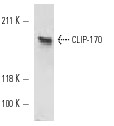
Western blot analysis of CLIP-170 expression in T2.DR3 whole cell lysate.| Product Name | CLIP-170 Antibody (H-300) |
|---|---|
| Antibody Type | Primary Antibodies |
| Antigen Alias | raised against amino acids 1128-1427 mapping at the C-terminus of CLIP-170 of human origin |
| Modification Notes | Cytoplasmic linker protein (CLIP-170) is the original member of a group of microtuble binding proteins designated as plus-end-binding proteins (+TIPs). CLIP-170 binds to the growing plus ends of microtubules and acts as a linker between the dynamic microtubule ends and organelle membranes. The protein acts as an anticatastrophic factor, promoting microtubule rescue near the cell periphery. Fluorescently labeled CLIP-170 can be visualized as a comet like streak around the growing ends of microtubules. CLIP-170 co-localizes with Dynactin and Dynein at microtubule ends and also at the kinetochore. Restin, first identified as a marker for Hodgkin and Reed-Sternberg (HRS) cells, is a splice variant of the gene that includes a 35 amino acid stretch not present in CLIP-170. CLIP-170/restin is highly expressed in HRS cells, monocyte-derived dendritic cells, IL-4 + CD40L activated B cells and Ki-1 lymphoma. |
| Clonality | Polyclonal |
|---|---|
| Isotype | IgG |
| Host Species | Rabbit |
| Tested Applications | WBIPIFELISA |
| recommended for detection of CLIP-170 and restin of mouse, rat and human origin by WB, IP, IF and ELISA also reactive with additional species, including canine, bovine and porcine: |
|
| Species Reactivity | HumanMouseRat |
| Concentration | 1mg/ml |
| Purification | Affinity purified |
| Alternative Names | raised against amino acids 1128-1427 mapping at the C-terminus of CLIP-170 of human origin |
|---|---|
| Tissue Specificity | raised against amino acids 1128-1427 mapping at the C-terminus of CLIP-170 of human origin |
| Entrez Gene | 6249 |
|---|
Application
Western blot analysis of CLIP-170 expression in T2.DR3 whole cell lysate.| Application Notes | recommended for detection of CLIP-170 and restin of mouse, rat and human origin by WB, IP, IF and ELISA also reactive with additional species, including canine, bovine and porcine: |
|---|
| Form | Liquid |
|---|---|
| Storage Instructions | For short-term storage, store at 4° C. For long-term storage, aliquot and store at -20ºC or below. Avoid multiple freeze-thaw cycles. |
| Storage Buffer | phosphate buffered saline , pH 7.4, 150mM NaCl, 0.02% sodium azide and 50% glycerol. |


