Application
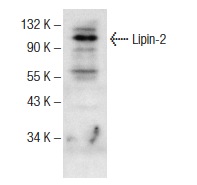
Western blot analysis of Lipin-2 expression in Jurkat whole cell lysate.| Product Name | Lipin-2 Antibody (H-160) |
|---|---|
| Antibody Type | Primary Antibodies |
| Antigen Alias | epitope corresponding to amino acids 246-405 mapping within an internal region of Lipin-2 of human origin |
| Modification Notes | The Lipin family of nuclear proteins contains three members: Lipin-1, Lipin-2, and Lipin-3, all of which contain a nuclear signal sequence, a highly conserved amino-terminal (NLIP) domain, and a carboxy-terminal (CLIP) domain. Lipin-2 is ubiquitously expressed in various tissues including brain, kidney, lung, heart, and skeletal muscles, and it is abundantly produced in the cornea, lens, retina, optic nerve, and sclera. The gene encoding for Lipin-2 contains 11 single nucleotide polymorphisms (SNPs). Mutations in the Lipin-2 gene commonly result in Majeed syndrome, and autosomal recessive, autoinflammatory disorder characterized by chronic multifocal osteomyelitis and and congenital dyserythropoietic anaemia. The symptoms of this syndrome include inflammation of the bone and skin, and recurrent fevers. |
| Clonality | Polyclonal |
|---|---|
| Isotype | IgG |
| Host Species | Rabbit |
| Tested Applications | WBIPIFELISA |
| recommended for detection of Lipin-2 of mouse, rat and human origin by WB, IP, IF and ELISA also reactive with additional species, including equine and canine: |
|
| Species Reactivity | HumanMouseRat |
| Concentration | 1mg/ml |
| Purification | Affinity purified |
| Alternative Names | epitope corresponding to amino acids 246-405 mapping within an internal region of Lipin-2 of human origin |
|---|---|
| Tissue Specificity | epitope corresponding to amino acids 246-405 mapping within an internal region of Lipin-2 of human origin |
Application
Western blot analysis of Lipin-2 expression in Jurkat whole cell lysate.| Application Notes | recommended for detection of Lipin-2 of mouse, rat and human origin by WB, IP, IF and ELISA also reactive with additional species, including equine and canine: |
|---|
| Form | Liquid |
|---|---|
| Storage Instructions | For short-term storage, store at 4° C. For long-term storage, aliquot and store at -20ºC or below. Avoid multiple freeze-thaw cycles. |
| Storage Buffer | phosphate buffered saline , pH 7.4, 150mM NaCl, 0.02% sodium azide and 50% glycerol. |


