Application
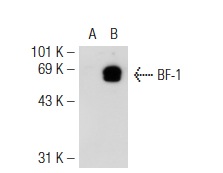
Western blot analysis of BF-1 expression in non-transfected: (A) and mouse BF-1 transfected: (B) 293T whole cell lysates.| Product Name | BF-1 Antibody (H-230) |
|---|---|
| Antibody Type | Primary Antibodies |
| Antigen Alias | epitope corresponding to amino acids 260-489 mapping at the C-terminus of BF-1 of human origin |
| Modification Notes | The winged-helix transcriptional repressor (WH) BF-1 gene encodes brain factor 1 (BF-1), also known as foxg1, and is essential for the proliferation of progenitor cells in the cerebral cortex and influences regional patterning in the mammalian telencephalon (1–4). WH proteins are a family of putative transcriptional regulators with diverse roles in development, and are characterized by a highly conserved DNA binding structure, the WH domain (1,5,6). BF-1 plays a critical role in the development of the cerebral hemispheres of the brain and targeted disruption of the gene leads to severe defects in the development of telencephalic structures, such as the cerebral cortex and basal ganglia (1). The loss of BF-1 results in an accelerated rate of neuronal differentiation and the shortening of the neurogenetic period in the embryonic cerebral cortex (1,7). BF-1 is expressed by E8.5 in telencephalic progenitors (1). It may also regulate the response of cerebral cortical progenitors to environmental cues (1). |
| Clonality | Polyclonal |
|---|---|
| Isotype | IgG |
| Host Species | Rabbit |
| Tested Applications | WBIPIFELISAGSChIP |
| recommended for detection of BF-1 of mouse, rat and human origin, BF-2 and BF-3 of human origin of mouse, rat and human origin by WB, IP, IF and ELISA also reactive with additional species, including equine, canine, bovine and avian: |
|
| Species Reactivity | HumanMouseRat |
| Concentration | 1mg/ml |
| Purification | Affinity purified |
| Alternative Names | epitope corresponding to amino acids 260-489 mapping at the C-terminus of BF-1 of human origin |
|---|---|
| Tissue Specificity | epitope corresponding to amino acids 260-489 mapping at the C-terminus of BF-1 of human origin |
| Entrez Gene | 2290 |
|---|
Application
Western blot analysis of BF-1 expression in non-transfected: (A) and mouse BF-1 transfected: (B) 293T whole cell lysates.| Application Notes | recommended for detection of BF-1 of mouse, rat and human origin, BF-2 and BF-3 of human origin of mouse, rat and human origin by WB, IP, IF and ELISA also reactive with additional species, including equine, canine, bovine and avian: |
|---|
| Form | Liquid |
|---|---|
| Storage Instructions | For short-term storage, store at 4° C. For long-term storage, aliquot and store at -20ºC or below. Avoid multiple freeze-thaw cycles. |
| Storage Buffer | phosphate buffered saline , pH 7.4, 150mM NaCl, 0.02% sodium azide and 50% glycerol. |


