Application
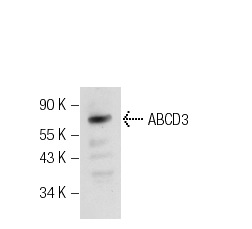
Western blot analysis of ABCD3 expression in HeLa whole cell lysate.Application
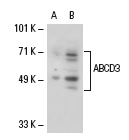
Western blot analysis of ABCD3 expression in non-transfected: (A) and human ABCD3 transfected: (B) 293 whole cell lysates.| Product Name | ABCD3 Antibody (H-195) |
|---|---|
| Antibody Type | Primary Antibodies |
| Antigen Alias | epitope corresponding to amino acids 280-475 mapping to an internal region of ABCD3 of human origin |
| Modification Notes | The peroxisomal membrane contains several ATP-binding cassette (ABC) transporters, ABCD1-4 that are known to be present in the human peroxisome membrane. All four proteins are ABC half-transporters, which dimerize to form an active transporter. A mutation in the ABCD1 gene causes X-linked adreno-leukodystrophy (X-ALD), a peroxisomal disorder which affects lipid storage. ABCD2 in mouse is expressed at high levels in the brain and adrenal organs, which are adversely affected in X-ALD. The peroxisomal membrane comprises two quantitatively major proteins, PMP22 and ABCD3. ABCD3 is associated with irregularly shaped vesicles which may be defective peroxisomes or peroxisome precursors. ABCD1 localizes to peroxisomes. ABCB7 is a half-transporter involved in the transport of heme from the mitochondria to the cytosol. |
| Clonality | Polyclonal |
|---|---|
| Isotype | IgG |
| Host Species | Rabbit |
| Tested Applications | WBIPIFELISA |
| recommended for detection of ABCD3 of mouse, rat and human origin by WB, IP, IF and ELISA also reactive with additional species, including equine, canine, bovine, porcine and avian: |
|
| Species Reactivity | HumanMouseRat |
| Concentration | 1mg/ml |
| Purification | Affinity purified |
| Alternative Names | epitope corresponding to amino acids 280-475 mapping to an internal region of ABCD3 of human origin |
|---|---|
| Tissue Specificity | epitope corresponding to amino acids 280-475 mapping to an internal region of ABCD3 of human origin |
| Entrez Gene | 5825 |
|---|
Application
Western blot analysis of ABCD3 expression in HeLa whole cell lysate.
Application
Western blot analysis of ABCD3 expression in non-transfected: (A) and human ABCD3 transfected: (B) 293 whole cell lysates.| Application Notes | recommended for detection of ABCD3 of mouse, rat and human origin by WB, IP, IF and ELISA also reactive with additional species, including equine, canine, bovine, porcine and avian: |
|---|
| Form | Liquid |
|---|---|
| Storage Instructions | For short-term storage, store at 4° C. For long-term storage, aliquot and store at -20ºC or below. Avoid multiple freeze-thaw cycles. |
| Storage Buffer | phosphate buffered saline , pH 7.4, 150mM NaCl, 0.02% sodium azide and 50% glycerol. |


