Application
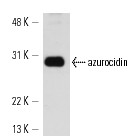
Western blot analysis of human recombinant azurocidin fusion protein.| Product Name | azurocidin Antibody (H-70) |
|---|---|
| Antibody Type | Primary Antibodies |
| Antigen Alias | epitope corresponding to amino acids 156-225 mapping within an internal region of azurocidin of human origin |
| Modification Notes | Azurocidin is a multifunctional endotoxin-binding serine protease homolog that accumulates in azurophil granules during the promyelocytic stage of neutrophil differentiation. The human azurocidin gene maps to chromosome 19p13.3 and encodes a 251 amino acid protein. The genes encoding azurocidin, neutrophil elastase, and proteinase 3 are in a cluster located at the tip of the short arm of chromosome 19. Each of these three proteins are expressed coordinately and their protein products are packaged together into azurophil granules. When released from activated granulocytes, azurocidin potentiates bacterial uptake in monocytes and enhances the potential of microbial killing in monocytes and granulocytes. Azurocidin potentiates the LPS-induced release of proinflammatory cytokines (TNF-alpha, IL-1, and IL-6) from isolated human monocytes. In addition azurocidin induces Ca++-dependent cytoskeletal rearrangement and intercellular gap formation in endothelial-cell monolayers in vitro, and increases macromolecular efflux in microvessels in vivo. Selective inactivation of azurocidin prevents azurophil granule containing neutrophils from inducing endothelial hyper-permeability, suggesting that azurocidin plays a central role in neutrophil trafficking during inflammation. |
| Clonality | Polyclonal |
|---|---|
| Isotype | IgG |
| Host Species | Rabbit |
| Tested Applications | WBIPIFELISA |
| recommended for detection of azurocidin of human origin by WB, IP, IF and ELISA: |
|
| Species Reactivity | HumanMouseRat |
| Concentration | 1mg/ml |
| Purification | Affinity purified |
| Alternative Names | epitope corresponding to amino acids 156-225 mapping within an internal region of azurocidin of human origin |
|---|---|
| Tissue Specificity | epitope corresponding to amino acids 156-225 mapping within an internal region of azurocidin of human origin |
| Entrez Gene | 566 |
|---|
Application
Western blot analysis of human recombinant azurocidin fusion protein.| Application Notes | recommended for detection of azurocidin of human origin by WB, IP, IF and ELISA: |
|---|
| Form | Liquid |
|---|---|
| Storage Instructions | For short-term storage, store at 4° C. For long-term storage, aliquot and store at -20ºC or below. Avoid multiple freeze-thaw cycles. |
| Storage Buffer | phosphate buffered saline , pH 7.4, 150mM NaCl, 0.02% sodium azide and 50% glycerol. |


