Application
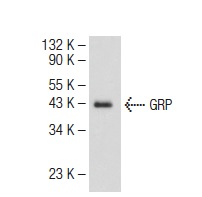
Western blot analysis of full length human recombinant GRP.| Product Name | GRP Antibody (FL-148) |
|---|---|
| Antibody Type | Primary Antibodies |
| Antigen Alias | epitope corresponding to amino acids 1-148 representing full length GRP of human origin |
| Modification Notes | Gastrin, which is normally formed by mucosal cells in the gastric antrum and by the D cells of the pancreatic islets, is a hormone whose main function is to stimulate secretion of HCl by the gastric mucosa. HCl, in turn, inhibits gastrin formation. Gastrin also stimulates smooth muscle contraction and increases blood circulation and water secretion in the stomach and intestine. Gastrin is regulated by epidermal growth factor in both mice and humans. Gastrin is excreted in excess by pancreatic tumors in the Zollinger-Ellison syndrome. Gastrin maps to human chromosome 17q12. Gastrin-releasing peptide (GRP) stimulates the release of gastrin as well as other gastrointestinal hormones, in addition to acting as an autocrine growth factor for certain cell types. GRP is known to promote lung tumorigenesis in model systems and, interestingly, is induced by retinoic acid. GRP is involved in several functions with the hypothalamus, and is thought to play a role in regulating pituitary hormone secretion. GRP maps to human chromosome 18q21. |
| Clonality | Polyclonal |
|---|---|
| Isotype | IgG |
| Host Species | Rabbit |
| Tested Applications | WBIPIFELISA |
| recommended for detection of GRP and neuromedin C active peptides of human and, to a lesser extent, mouse and rat origin by WB, IP, IF and ELISA: |
|
| Species Reactivity | HumanMouseRat |
| Concentration | 1mg/ml |
| Purification | Affinity purified |
| Alternative Names | epitope corresponding to amino acids 1-148 representing full length GRP of human origin |
|---|---|
| Tissue Specificity | epitope corresponding to amino acids 1-148 representing full length GRP of human origin |
| Entrez Gene | 2922 |
|---|
Application
Western blot analysis of full length human recombinant GRP.| Application Notes | recommended for detection of GRP and neuromedin C active peptides of human and, to a lesser extent, mouse and rat origin by WB, IP, IF and ELISA: |
|---|
| Form | Liquid |
|---|---|
| Storage Instructions | For short-term storage, store at 4° C. For long-term storage, aliquot and store at -20ºC or below. Avoid multiple freeze-thaw cycles. |
| Storage Buffer | phosphate buffered saline , pH 7.4, 150mM NaCl, 0.02% sodium azide and 50% glycerol. |


