Application
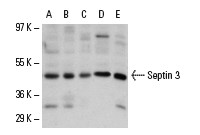
Western blot analysis of Septin 3 expression in M1 (A), EOC 13.31 (B), MCP-5 (C), IMR-32 (D) and Jurkat (E) whole cell lysates.Application
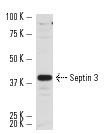
Western blot analysis of Septin 3 expression in rat brain tissue extract.| Product Name | Septin 3 Antibody (H-50) |
|---|---|
| Antibody Type | Primary Antibodies |
| Antigen Alias | epitope corresponding to amino acids 1-50 mapping at the N-terminus of Septin 3 of human origin |
| Modification Notes | The septins are a family of GTPase enzymes, some of which are required for cytokinesis and others of which are associated with exocytosis. Members of the septin family can form heteropolymer complexes and also play a role in the organization of new growth in organisms. The transcriptional regulation of all septins is complex, resulting in alternatively spliced variants. At least three septins (Septin 1, 2 and 4) are associated with a tau-based paired helical filament core and may contribute to the formation of neurofibrillary tangle as integral constituents of paired helical filaments. Septin 3 (G-Septin), a GTP-binding protein, is highly expressed in brain and is regulated by protein kinase G in neurons. The human SEPT4 (H5/PNUTL2/CDCREL-2) gene encodes ARTS (for apoptosis-related protein in the TGF-∫ signaling pathway), which is expressed in many cells and acts to enhance cell death induced by TGF-∫ or, to a lesser extent, by other apoptotic agents. ARTS is localized to mitochondria and translocates to the nucleus when apoptosis occurs. Septin 5 is a major form of the CDCREL-1 septin in the adult neocortex of mammals. Human Septin 6 protein contains an ATP-GTP binding motif and three nuclear targeting sequences in its C-terminus. Septin 6 is the third septin member that is fused to the MLL protein, in addition to hCDCREL and MSF. |
| Clonality | Polyclonal |
|---|---|
| Isotype | IgG |
| Host Species | Rabbit |
| Tested Applications | WBIPIFELISA |
| recommended for detection of Septin 3 of mouse, rat and human origin by WB, IP, IF and ELISA also reactive with additional species, including equine, canine, bovine, porcine and avian: |
|
| Species Reactivity | HumanMouseRat |
| Concentration | 1mg/ml |
| Purification | Affinity purified |
| Alternative Names | epitope corresponding to amino acids 1-50 mapping at the N-terminus of Septin 3 of human origin |
|---|---|
| Tissue Specificity | epitope corresponding to amino acids 1-50 mapping at the N-terminus of Septin 3 of human origin |
| Entrez Gene | 55964 |
|---|
Application
Western blot analysis of Septin 3 expression in M1 (A), EOC 13.31 (B), MCP-5 (C), IMR-32 (D) and Jurkat (E) whole cell lysates.
Application
Western blot analysis of Septin 3 expression in rat brain tissue extract.| Application Notes | recommended for detection of Septin 3 of mouse, rat and human origin by WB, IP, IF and ELISA also reactive with additional species, including equine, canine, bovine, porcine and avian: |
|---|
| Form | Liquid |
|---|---|
| Storage Instructions | For short-term storage, store at 4° C. For long-term storage, aliquot and store at -20ºC or below. Avoid multiple freeze-thaw cycles. |
| Storage Buffer | phosphate buffered saline , pH 7.4, 150mM NaCl, 0.02% sodium azide and 50% glycerol. |


