Application
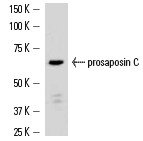
Western blot analysis of prosaposin C expression in mouse spleen tissue extract.| Product Name | saposin C Antibody (M-85) |
|---|---|
| Antibody Type | Primary Antibodies |
| Antigen Alias | epitope corresponding to amino acids 301-385 mapping within an internal region of saposin C of mouse origin |
| Modification Notes | The saposin family includes four structurally related activator proteins, saposin A, B, C and D, that are cleaved from the single precursor protein prosaposin. The gene encoding human prosaposin maps to chromosome 10. Prosaposin is synthesized as a protein that is posttranslationally modified to a shorter form and then further glycosylated to yield a secretory product. This form subsequently undergoes partial proteolysis to produce saposin A, B, C and D. Each saposin family member acts in conjunction with hydrolase enzymes to facilitate the breakdown of glycosphingolipids within the lysosome. The saposins modify the environment of target lipids to make them accessible to the active sites of specific enzymes. Saposin A and C are involved in the hydrolysis of glucosylceramidase, and defects in saposin C are linked to Gaucher’s disease. Saposin B facilitates the hydrolysis of the sulfate group from cerebroside sulfate, and defects in this protein are responsible for a form of metachromatic leukodystropy, a progressive neurodegenerative condition. Saposin D may stimulate the hydrolysis of sphingomyelin and ceramide, but its exact physiological role is not clear. |
| Clonality | Polyclonal |
|---|---|
| Isotype | IgG |
| Host Species | Rabbit |
| Tested Applications | WBIPIFELISA |
| recommended for detection of prosaposin and mature saposin C of mouse and, to a lesser extent, rat origin by WB, IP, IF and ELISA: |
|
| Species Reactivity | HumanMouseRat |
| Concentration | 1mg/ml |
| Purification | Affinity purified |
| Alternative Names | epitope corresponding to amino acids 301-385 mapping within an internal region of saposin C of mouse origin |
|---|---|
| Tissue Specificity | epitope corresponding to amino acids 301-385 mapping within an internal region of saposin C of mouse origin |
| Entrez Gene | 19156 |
|---|
Application
Western blot analysis of prosaposin C expression in mouse spleen tissue extract.| Application Notes | recommended for detection of prosaposin and mature saposin C of mouse and, to a lesser extent, rat origin by WB, IP, IF and ELISA: |
|---|
| Form | Liquid |
|---|---|
| Storage Instructions | For short-term storage, store at 4° C. For long-term storage, aliquot and store at -20ºC or below. Avoid multiple freeze-thaw cycles. |
| Storage Buffer | phosphate buffered saline , pH 7.4, 150mM NaCl, 0.02% sodium azide and 50% glycerol. |


