Application
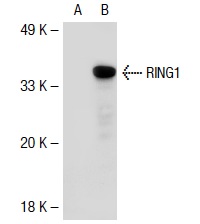
Western blot analysis of RING1 expression in non-transfected: (A) and mouse RING1 transfected: (B) 293T whole cell lysates.| Product Name | RING1 Antibody (H-110) |
|---|---|
| Antibody Type | Primary Antibodies |
| Antigen Alias | epitope corresponding to amino acids 121-230 mapping within an internal region of RING1 of human origin |
| Modification Notes | In Drosophila, the Polycomb (PcG) gene family encodes chromatin proteins that are required for the repression of homeotic loci during embryonic development. The human PcG homologues form two distinct multimeric protein complexes, the EED/EZH protein complex and the HPC/HPH protein complex, which have mutually exclusive expression patterns. The HPC/HPH PcG complex contains the human polycomb 2 (HPC2), human polyhomeotic (HPH), Bmi-1 and RING1 proteins. The human RING1 gene, which is proximal to the major histocompatibility complex region on chromosome six, encodes for a protein that contains a RING finger motif, a zinc-binding domain found in many regulatory proteins, but unlike the other human PcG genes, RING1 displays no homology to known Drosophila PcG genes. RING1 strongly represses En-2, the mammalian homolog of the Drosophila engrailed gene, and when overexpressed, it mediates an increase in the expression of proto-oncogenes, such as c-Jun and c-fos. Also, loss of RING1 and Bmi-1 expression correlates with the differentiation of B cells, which suggests a role for RING1 in germinal center development. |
| Clonality | Polyclonal |
|---|---|
| Isotype | IgG |
| Host Species | Rabbit |
| Tested Applications | WBIPIFELISAGSChIP |
| recommended for detection of RING1 of mouse, rat and human origin by WB, IP, IF and ELISA: |
|
| Species Reactivity | HumanMouseRat |
| Concentration | 1mg/ml |
| Purification | Affinity purified |
| Alternative Names | epitope corresponding to amino acids 121-230 mapping within an internal region of RING1 of human origin |
|---|---|
| Tissue Specificity | epitope corresponding to amino acids 121-230 mapping within an internal region of RING1 of human origin |
| Entrez Gene | 6015 |
|---|
Application
Western blot analysis of RING1 expression in non-transfected: (A) and mouse RING1 transfected: (B) 293T whole cell lysates.| Application Notes | recommended for detection of RING1 of mouse, rat and human origin by WB, IP, IF and ELISA: |
|---|
| Form | Liquid |
|---|---|
| Storage Instructions | For short-term storage, store at 4° C. For long-term storage, aliquot and store at -20ºC or below. Avoid multiple freeze-thaw cycles. |
| Storage Buffer | phosphate buffered saline , pH 7.4, 150mM NaCl, 0.02% sodium azide and 50% glycerol. |


