Application
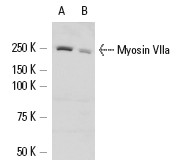
Western blot analysis of Myosin VIIa expression in Y79 whole cell lysate (A) and Y79 nuclear extract (B).| Product Name | Myosin VIIa Antibody (H-60) |
|---|---|
| Antibody Type | Primary Antibodies |
| Antigen Alias | epitope corresponding to amino acids 11-70 mapping near the N-terminus of Myosin VIIa of human origin |
| Modification Notes | Myosins are molecular motors that move along filamentous Actin and influence cellular movements such as phagocytosis. There are seven classes of myosins in vertebrates, including Myosin II, and six unconventional Myosin classes, designated I, V, VI, VII, IX and X. Myosin VIIa is a plus end-directed motor that influences cilia formation and cell adhesion. Mutations in the human Myosin VIIa gene correlate with Usher syndrome, a disease characterized by congenital sensorineural deafness, vestibular dysfunction and retinitis pigmentosa. |
| Clonality | Polyclonal |
|---|---|
| Isotype | IgG |
| Host Species | Rabbit |
| Tested Applications | WBIPIFELISA |
| recommended for detection of Myosin VIIa isoforms of mouse, rat and human origin by WB, IP, IF and ELISA also reactive with additional species, including bovine and porcine: |
|
| Species Reactivity | HumanMouseRat |
| Concentration | 1mg/ml |
| Purification | Affinity purified |
| Alternative Names | epitope corresponding to amino acids 11-70 mapping near the N-terminus of Myosin VIIa of human origin |
|---|---|
| Tissue Specificity | epitope corresponding to amino acids 11-70 mapping near the N-terminus of Myosin VIIa of human origin |
| Entrez Gene | 4647 |
|---|
Application
Western blot analysis of Myosin VIIa expression in Y79 whole cell lysate (A) and Y79 nuclear extract (B).| Application Notes | recommended for detection of Myosin VIIa isoforms of mouse, rat and human origin by WB, IP, IF and ELISA also reactive with additional species, including bovine and porcine: |
|---|
| Form | Liquid |
|---|---|
| Storage Instructions | For short-term storage, store at 4° C. For long-term storage, aliquot and store at -20ºC or below. Avoid multiple freeze-thaw cycles. |
| Storage Buffer | phosphate buffered saline , pH 7.4, 150mM NaCl, 0.02% sodium azide and 50% glycerol. |


