Application
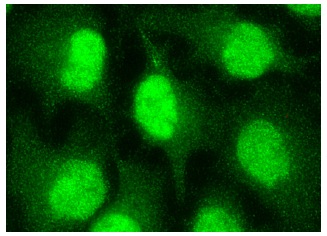
Immunofluorescence staining of methanol-fixed HeLa cells showing nuclear localization.Application
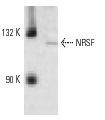
Western blot analysis of NRSF expression in RAW 264.7 nuclear extract.| Product Name | NRSF Antibody (H-290) |
|---|---|
| Antibody Type | Primary Antibodies |
| Antigen Alias | epitope corresponding to amino acids 1-290 of NRSF of human origin |
| Modification Notes | NRSF (neuron-restrictive silencer factor, also designated XBR and REST for RE1-silencing factor) is a silencer protein that binds the DNA sequence element NRSE (neuron-restrictive silencer element). The binding of NRSF to the NRSE represses neuronal gene transcription in non-neuronal cells. Although NRSF is most highly expressed in non-neural tissues, it is also expressed in developing neurons and at low levels in the brain. NRSF contains nine zinc-finger domains, but also exists as a C-terminally truncated form produced by alternative splicing. This variant, REST4, contains five of the zinc-finger domains and weakly binds DNA, yet is transported to the nucleus. NRSF associates with mSin3 and HDAC in ventricular myocytes, suggesting a role for NRSF outside the nervous system. Down-regulation of NRSF, which normally occurs upon neural differentiation, is necessary for the proper development of certain classes of neurons. NRSF is required to repress neuronal gene expression in vivo, in both extra-neural and undifferentiated neural tissue. |
| Clonality | Polyclonal |
|---|---|
| Isotype | IgG |
| Host Species | Rabbit |
| Tested Applications | WBIPIFELISAGSChIP |
| recommended for detection of NRSF of mouse, rat and human origin by WB, IP, IF and ELISA also reactive with additional species, including equine, canine and bovine: |
|
| Species Reactivity | HumanMouseRat |
| Concentration | 1mg/ml |
| Purification | Affinity purified |
| Alternative Names | epitope corresponding to amino acids 1-290 of NRSF of human origin |
|---|---|
| Tissue Specificity | epitope corresponding to amino acids 1-290 of NRSF of human origin |
| Entrez Gene | 5978 |
|---|
Application
Immunofluorescence staining of methanol-fixed HeLa cells showing nuclear localization.
Application
Western blot analysis of NRSF expression in RAW 264.7 nuclear extract.| Application Notes | recommended for detection of NRSF of mouse, rat and human origin by WB, IP, IF and ELISA also reactive with additional species, including equine, canine and bovine: |
|---|
| Form | Liquid |
|---|---|
| Storage Instructions | For short-term storage, store at 4° C. For long-term storage, aliquot and store at -20ºC or below. Avoid multiple freeze-thaw cycles. |
| Storage Buffer | phosphate buffered saline , pH 7.4, 150mM NaCl, 0.02% sodium azide and 50% glycerol. |


