Application
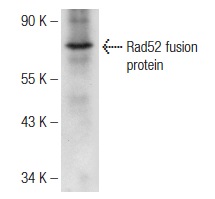
Western blot analysis of goat recombinant Rad52 fusion protein.| Product Name | Rad52 Antibody (y-300) |
|---|---|
| Antibody Type | Primary Antibodies |
| Antigen Alias | epitope corresponding to amino acids 205-504 mapping at the C-terminus of Rad52 of Saccharomyces cerevisiae origin |
| Modification Notes | Rad52 family members (Rad50, Rad51B/C/D, Rad52, Rad54, MRE11) mediate DNA double-strand break repair (DSBR) for DNA damage that otherwise could cause cell death, mutation or neoplastic transformation. Rad51 (RECA, BRCC5) interacts with BRCA1 and BRCA2 to influence subcellular localization and cellular response to DNA damage. BRCA2 inactivation may be a key event leading to genomic instability and tumorigenesis from deregulation of Rad51. Rad52 forms a heptameric ring that binds single-stranded DNA ends and catalyzes DNA-DNA interaction necessary for the annealing of complementary strands. Rad52 can interact with Rad51. Rad54A of the DEAD-like helicase superfamily binds to double-strand DNA and induces a DNA topological change, which is thought to facilitate homologous DNA pairing and stimulate DNA recombination. Rad54B of the DEAD-like helicase superfamily binds to double-stranded DNA and displays ATPase activity in the presence of DNA. Rad54B is abundant in testis and spleen, and mutations of this gene occur in primary lymphoma and colon cancer. |
| Clonality | Polyclonal |
|---|---|
| Isotype | IgG |
| Host Species | Rabbit |
| Tested Applications | WBIPIFELISA |
| recommended for detection of Rad52 of Saccharomyces cerevisiae origin by WB, IP, IF and ELISA: |
|
| Species Reactivity | HumanMouseRat |
| Concentration | 1mg/ml |
| Purification | Affinity purified |
| Alternative Names | epitope corresponding to amino acids 205-504 mapping at the C-terminus of Rad52 of Saccharomyces cerevisiae origin |
|---|---|
| Tissue Specificity | epitope corresponding to amino acids 205-504 mapping at the C-terminus of Rad52 of Saccharomyces cerevisiae origin |
Application
Western blot analysis of goat recombinant Rad52 fusion protein.| Application Notes | recommended for detection of Rad52 of Saccharomyces cerevisiae origin by WB, IP, IF and ELISA: |
|---|
| Form | Liquid |
|---|---|
| Storage Instructions | For short-term storage, store at 4° C. For long-term storage, aliquot and store at -20ºC or below. Avoid multiple freeze-thaw cycles. |
| Storage Buffer | phosphate buffered saline , pH 7.4, 150mM NaCl, 0.02% sodium azide and 50% glycerol. |


