Application
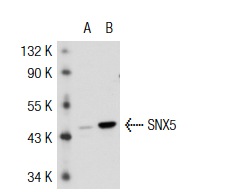
Western blot analysis of SNX5 expression in non-transfected: (A) and mouse SNX5 transfected: (B) 293T whole cell lysates.| Product Name | SNX5 Antibody (H-40) |
|---|---|
| Antibody Type | Primary Antibodies |
| Antigen Alias | epitope corresponding to amino acids 1-40 mapping at the N-terminus of SNX5 of human origin |
| Modification Notes | Sorting nexin 1 (SNX1) is a member of a large family of hydrophilic proteins that interact with a variety of receptor types and are involved in intracellular trafficking (1). SNX1 and the related splice variant, SNX1A, bind the epidermal growth factor (EGF) receptor, facilitate its transport to lysosome, and thereby contribute to the degradation of the receptor (2,3). SNX2 and SNX4 share a high degree of amino acid similarity with SNX1, as they all contain a characteristic phox homology (PX) domain (4). These proteins are all partially associated with cellular membranes, and they, likewise, associate with EGF, PDGF and insulin receptor tyrosine kinases (2). These nexins are widely expressed and yet have various tissue distribution patterns. Additionally, the sorting nexins can associate with each other and with a variety of other cellular proteins, suggesting that they exist as part of multisubunit complexes (1,5). The related protein, SNX3, comprises a distinct subgroup of nexins that share less sequence similarity outside of the PX domain and have dramatically different binding affinities for the tyrosine kinase receptors (2,6). |
| Clonality | Polyclonal |
|---|---|
| Isotype | IgG |
| Host Species | Rabbit |
| Tested Applications | WBIPIFELISA |
| recommended for detection of SNX5 of mouse, rat and human origin by WB, IP, IF and ELISA also reactive with additional species, including canine and bovine: |
|
| Species Reactivity | HumanMouseRat |
| Concentration | 1mg/ml |
| Purification | Affinity purified |
| Alternative Names | epitope corresponding to amino acids 1-40 mapping at the N-terminus of SNX5 of human origin |
|---|---|
| Tissue Specificity | epitope corresponding to amino acids 1-40 mapping at the N-terminus of SNX5 of human origin |
| Entrez Gene | 27131 |
|---|
Application
Western blot analysis of SNX5 expression in non-transfected: (A) and mouse SNX5 transfected: (B) 293T whole cell lysates.| Application Notes | recommended for detection of SNX5 of mouse, rat and human origin by WB, IP, IF and ELISA also reactive with additional species, including canine and bovine: |
|---|
| Form | Liquid |
|---|---|
| Storage Instructions | For short-term storage, store at 4° C. For long-term storage, aliquot and store at -20ºC or below. Avoid multiple freeze-thaw cycles. |
| Storage Buffer | phosphate buffered saline , pH 7.4, 150mM NaCl, 0.02% sodium azide and 50% glycerol. |


