Application
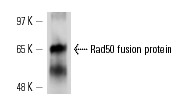
Western blot analysis of yeast recombinant Rad50 fusion protein.| Product Name | Rad50 Antibody (y-300) |
|---|---|
| Antibody Type | Primary Antibodies |
| Antigen Alias | epitope corresponding to amino acids 1013-1312 mapping at the C-terminus of Rad50 of IF and IHC(P) origin |
| Modification Notes | Multiple pathways promote short-sequence recombination (SSR) in Saccharomyces cerevisiae. When gene conversion is initiated by a double-strand break (DSB), any nonhomologous DNA that may be present at the ends must be removed before new DNA synthesis can be initiated. Removal of a 3' nonhomologous tail in S. cerevisiae depends on the nucleotide excision repair endonuclease Rad1/Rad10, and also on the mismatch repair proteins Msh2 and Msh3. Also important for SSR is the MRE11 complex (also known as M/R/X), which is a multisubunit nuclease composed of MRE11, Rad50 and Nbs1/Xrs2. Genetic evidence suggests that Rad1/10 and M/R/X act on the same class of substrates during SSR. The MRE11 complex plays a central role in chromosomal maintenance and functions in homologous recombination, telomere maintenance and sister chromatid association. Mutations in the genes that encode components of the MRE11 complex result in DNA-damage sensitivity, genomic instability, telomere shortening and aberrant meiosis. Specifically, Rad50 contains a zinc-hook structure involved in joining MRE11 complexes in DNA recombination and repair. |
| Clonality | Polyclonal |
|---|---|
| Isotype | IgG |
| Host Species | Rabbit |
| Tested Applications | WBIPIFELISA |
| recommended for detection of Rad50 of Saccharomyces cerevisiae origin by WB, IP, IF and ELISA: |
|
| Species Reactivity | HumanMouseRat |
| Concentration | 1mg/ml |
| Purification | Affinity purified |
| Alternative Names | epitope corresponding to amino acids 1013-1312 mapping at the C-terminus of Rad50 of IF and IHC(P) origin |
|---|---|
| Tissue Specificity | epitope corresponding to amino acids 1013-1312 mapping at the C-terminus of Rad50 of IF and IHC(P) origin |
Application
Western blot analysis of yeast recombinant Rad50 fusion protein.| Application Notes | recommended for detection of Rad50 of Saccharomyces cerevisiae origin by WB, IP, IF and ELISA: |
|---|
| Form | Liquid |
|---|---|
| Storage Instructions | For short-term storage, store at 4° C. For long-term storage, aliquot and store at -20ºC or below. Avoid multiple freeze-thaw cycles. |
| Storage Buffer | phosphate buffered saline , pH 7.4, 150mM NaCl, 0.02% sodium azide and 50% glycerol. |


