Application
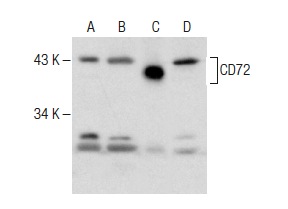
Western blot analysis of CD72 expression in WEHI-231 (A), PC-12 (B), NFS-5 C-1 (C) and P388D1 (D) whole cell lysates.| Product Name | CD72 Antibody (H-224) FITC |
|---|---|
| Antibody Type | Primary Antibodies |
| Antigen Alias | epitope corresponding to amino acids 117-361 mapping within the extracellular domain of CD72 of mouse origin |
| Modification Notes | CD5 has been identified as a transmembrane glycoprotein that is expressed on 70% of normal peripheral blood lymphocytes and on virtually all T lymphocytes in thymus and peripheral blood. Activation of T cells through the T cell receptor (TCR) results in tyrosine phosphorylation of CD5, and the absence of CD5 renders T cells hyper-responsive to TCR-mediated activation. CD5 associates with the TCR/CD3 Ω chain, and with the Src family kinase, Lck p56. The C-type lectin superfamily member CD72 is a cell surface negative regulator of B cell activation from the pro-B through the mature B cell stage. CD72 serves as a receptor for CD5. The ability of lymphocytes to respond to antigenic or mitogenic stimulation utilizes both positive and negative regulatory proteins that influence the threshold for responsiveness. The human CD72 gene maps to chromosome 9p13.3 and encodes a transmembrane glycoprotein that contains an immunoreceptor tyrosine-based inhibition motif (ITIM). Upon tyrosine phosphorylation, the CD72 ITIM recruits SH2-containing phosphatases such as SHP-1, resulting in downregulation of cell activation. CD72-/- mice contain hyperproliferative B cells. |
| Clonality | Polyclonal |
|---|---|
| Isotype | IgG |
| Host Species | Rabbit |
| Tested Applications | WBIPIFELISA |
| recommended for detection of CD72 of mouse and rat origin by WB, IP, IF and ELISA: |
|
| Species Reactivity | HumanMouseRat |
| Concentration | 1mg/ml |
| Purification | Affinity purified |
| Alternative Names | epitope corresponding to amino acids 117-361 mapping within the extracellular domain of CD72 of mouse origin |
|---|---|
| Tissue Specificity | epitope corresponding to amino acids 117-361 mapping within the extracellular domain of CD72 of mouse origin |
| Entrez Gene | 12517 |
|---|
Application
Western blot analysis of CD72 expression in WEHI-231 (A), PC-12 (B), NFS-5 C-1 (C) and P388D1 (D) whole cell lysates.| Application Notes | recommended for detection of CD72 of mouse and rat origin by WB, IP, IF and ELISA: |
|---|
| Form | Liquid |
|---|---|
| Storage Instructions | For short-term storage, store at 4° C. For long-term storage, aliquot and store at -20ºC or below. Avoid multiple freeze-thaw cycles. |
| Storage Buffer | phosphate buffered saline , pH 7.4, 150mM NaCl, 0.02% sodium azide and 50% glycerol. |


