Application
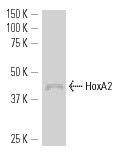
Western blot analysis of HoxA2 expression in DU 145 whole cell lysate.| Product Name | HoxA2 Antibody (H-130) |
|---|---|
| Antibody Type | Primary Antibodies |
| Antigen Alias | epitope corresponding to amino acids 201-330 of HoxA2 of human origin |
| Modification Notes | HOX genes play a fundamental role in the development of the vertebrate central nervous system, heart, axial skeleton, limbs, gut, urogenital tract and external genitalia. The homeobox gene Hoxa-1 is transcriptionally regulated by retinoic acid (RA) and encodes a transcription factor, which has been shown to play important roles in cell differentiation and embryogenesis. Hoxa-1 is also expressed in cancers, such as mammary tumors, though it is not expressed in normal gland or in precancerous mammary tissues. At embryonic stages, Hoxa-2 is expressed in the mesenchyme and epithelial cells of palate, however its expression is restricted to the tips of the growing palatal shelves. Hoxa-2 protein is predominantly expressed in the nuclei of cells in the ventral mantle region of the developing embryo. In the developing and adult mouse spinal cord, Hoxa-2 protein may contribute to dorsal-ventral patterning and/or to the specification of neuronal phenotype. Hoxa-7 functions as a potent transcriptional repressor and its action as such requires several domains, including both activator and repressor regions. Hoxa-7 is expressed in the fetal liver, lung, skeletal muscle, kidney, pancreas and placenta. |
| Clonality | Polyclonal |
|---|---|
| Isotype | IgG |
| Host Species | Rabbit |
| Tested Applications | WBIPIFELISAGSChIP |
| recommended for detection of HoxA2 of mouse, rat and human origin by WB, IP, IF and ELISA also reactive with additional species, including equine, canine, bovine and porcine: |
|
| Species Reactivity | HumanMouseRat |
| Concentration | 1mg/ml |
| Purification | Affinity purified |
| Alternative Names | epitope corresponding to amino acids 201-330 of HoxA2 of human origin |
|---|---|
| Tissue Specificity | epitope corresponding to amino acids 201-330 of HoxA2 of human origin |
| Entrez Gene | 3199 |
|---|
Application
Western blot analysis of HoxA2 expression in DU 145 whole cell lysate.| Application Notes | recommended for detection of HoxA2 of mouse, rat and human origin by WB, IP, IF and ELISA also reactive with additional species, including equine, canine, bovine and porcine: |
|---|
| Form | Liquid |
|---|---|
| Storage Instructions | For short-term storage, store at 4° C. For long-term storage, aliquot and store at -20ºC or below. Avoid multiple freeze-thaw cycles. |
| Storage Buffer | phosphate buffered saline , pH 7.4, 150mM NaCl, 0.02% sodium azide and 50% glycerol. |


