Application
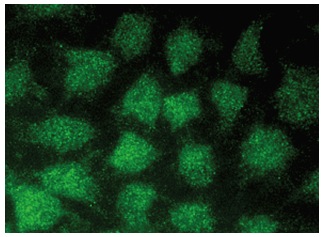
Immunofluorescence staining of methanol-fixed HeLa cells showing nuclear localization.Application
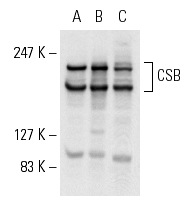
Western blot analysis of CSB expression in untreated HeLa (A), UV-treated HeLa (B) and BJAB (C) nuclear extracts.| Product Name | CSB Antibody (H-300) |
|---|---|
| Antibody Type | Primary Antibodies |
| Antigen Alias | epitope corresponding to amino acids 1-300 mapping at the N-terminus of CSB of human origin |
| Modification Notes | Nucleotide excision repair of DNA lesions occurs more rapidly and at a higher frequency on the template, or the transcribed, strand of DNA and to a much lesser extent on the coding, or the non-transcribed, strand or on transcriptionally inactive DNA. CSA and CSB are two related genes that are responsible for directing this preferential DNA repair pattern, known as transcriptional-repair coupling. Cells from patients with the UV-sensitive nucleotide excision repair disorder Cockayne's syndrome (CS) have specific mutations affecting these genes and results in defects of the preferential repair on the transcribed strand of activated genes. CSA is a protein that belongs in the "WD-repeat" family of proteins. CSB, which is also designated excision repair cross-complementing protein-6 (ERCC-6), is the homolog of the yeast Rad26 protein. CSB belongs in the SWI/SNF family of proteins as it contains helicase motifs and ATPase activity. |
| Clonality | Polyclonal |
|---|---|
| Isotype | IgG |
| Host Species | Rabbit |
| Tested Applications | WBIPIFELISA |
| recommended for detection of CSB of human origin by WB, IP, IF and ELISA also reactive with additional species, including equine: |
|
| Species Reactivity | HumanMouseRat |
| Concentration | 1mg/ml |
| Purification | Affinity purified |
| Alternative Names | epitope corresponding to amino acids 1-300 mapping at the N-terminus of CSB of human origin |
|---|---|
| Tissue Specificity | epitope corresponding to amino acids 1-300 mapping at the N-terminus of CSB of human origin |
| Entrez Gene | 2074 |
|---|
Application
Immunofluorescence staining of methanol-fixed HeLa cells showing nuclear localization.
Application
Western blot analysis of CSB expression in untreated HeLa (A), UV-treated HeLa (B) and BJAB (C) nuclear extracts.| Application Notes | recommended for detection of CSB of human origin by WB, IP, IF and ELISA also reactive with additional species, including equine: |
|---|
| Form | Liquid |
|---|---|
| Storage Instructions | For short-term storage, store at 4° C. For long-term storage, aliquot and store at -20ºC or below. Avoid multiple freeze-thaw cycles. |
| Storage Buffer | phosphate buffered saline , pH 7.4, 150mM NaCl, 0.02% sodium azide and 50% glycerol. |


