Application
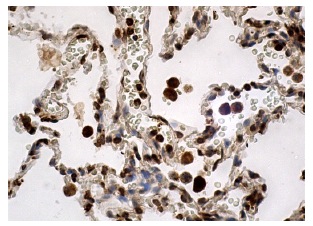
Immunoperoxidase staining of formalin fixed, paraffin-embedded human lung tissue showing cytoplasmic and nuclear staining of macrophages and pneumocytes.| Product Name | ECE-1 Antibody (H-60) |
|---|---|
| Antibody Type | Primary Antibodies |
| Antigen Alias | epitope corresponding to amino acids 331-390 mapping within an extracellular domain of ECE-1 of human origin |
| Modification Notes | Endothelin converting enzymes (ECE-1 and ECE-2) are type II metalloproteases that convert big endothelin-1 to vasoactive endothelin-1. Both ECE-1 and ECE-2 belong to the peptidase family M13 and are Type II membrane proteins. There are several different isoforms of each ECE protein and the expression of the protein may therefore vary. All isoforms are expressed in umbilical endothelial cells, atrium cardiomyocites and ventricles, polynuclear neutrophils and fibroblasts. Endothelin-converting enzyme-1 (ECE-1) converts big endothelin-1 to endothelin-1 by catalyzing the cleavage of the trp21-val22 bond in the precursor. The ECE-1 gene produces four isoforms from alternate promoters. The isoforms share the same extracellular catalytic domain and contain unique cytosolic tails, which results in their specific subcellular targeting. |
| Clonality | Polyclonal |
|---|---|
| Isotype | IgG |
| Host Species | Rabbit |
| Tested Applications | WBIPIFIHCELISA |
| recommended for detection of ECE-1 of mouse, rat and human origin by WB, IP, IF, IHC(P) and ELISA also reactive with additional species, including equine, canine, bovine and porcine: |
|
| Species Reactivity | HumanMouseRat |
| Concentration | 1mg/ml |
| Purification | Affinity purified |
| Alternative Names | epitope corresponding to amino acids 331-390 mapping within an extracellular domain of ECE-1 of human origin |
|---|---|
| Tissue Specificity | epitope corresponding to amino acids 331-390 mapping within an extracellular domain of ECE-1 of human origin |
| Entrez Gene | 1889 |
|---|
Application
Immunoperoxidase staining of formalin fixed, paraffin-embedded human lung tissue showing cytoplasmic and nuclear staining of macrophages and pneumocytes.| Application Notes | recommended for detection of ECE-1 of mouse, rat and human origin by WB, IP, IF, IHC(P) and ELISA also reactive with additional species, including equine, canine, bovine and porcine: |
|---|
| Form | Liquid |
|---|---|
| Storage Instructions | For short-term storage, store at 4° C. For long-term storage, aliquot and store at -20ºC or below. Avoid multiple freeze-thaw cycles. |
| Storage Buffer | phosphate buffered saline , pH 7.4, 150mM NaCl, 0.02% sodium azide and 50% glycerol. |


