Application
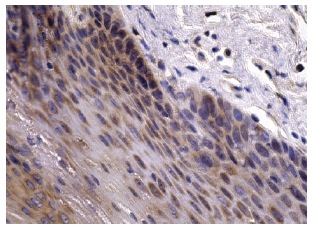
Immunoperoxidase staining of formalin fixed, paraffin-embedded human esophagus tissue showing cytoplasmic staining of squamous epithelial cells.| Product Name | Noggin Antibody (FL-232) |
|---|---|
| Antibody Type | Primary Antibodies |
| Antigen Alias | epitope corresponding to amino acids 1-232 representing full length Noggin of human origin |
| Modification Notes | Genetic differentiation of the vertebrate somite necessitates a balance of inductive signals and antagonists. Noggin is a secreted protein that binds and inactivates members of the transforming growth factor-beta (TGF∫) superfamily of signaling proteins, such as bone morphogenetic proteins-2, 4, 7 (BMP2, BMP4, BMP7). Inhibition of BMP signaling by axially secreted Noggin mediates normal vertebrate skeletogenesis and patterning of the neural tube and somite. Spatially, Noggin may effectively antagonize BMP activity by efficiently diffusing through extracellular matrices, thereby creating morpho-genic gradients. Mice embryos that are homozygous null for Noggin, a lethal genotype, display stubby, continuous limbs with lack of joints in the paws and an array of other developmental defects. |
| Clonality | Polyclonal |
|---|---|
| Isotype | IgG |
| Host Species | Rabbit |
| Tested Applications | WBIPIFIHCELISA |
| recommended for detection of Noggin of mouse, rat and human origin by WB, IP, IF, IHC(P) and ELISA also reactive with additional species, including canine, bovine and porcine: |
|
| Species Reactivity | HumanMouseRat |
| Concentration | 1mg/ml |
| Purification | Affinity purified |
| Alternative Names | epitope corresponding to amino acids 1-232 representing full length Noggin of human origin |
|---|---|
| Tissue Specificity | epitope corresponding to amino acids 1-232 representing full length Noggin of human origin |
| Entrez Gene | 9241 |
|---|
Application
Immunoperoxidase staining of formalin fixed, paraffin-embedded human esophagus tissue showing cytoplasmic staining of squamous epithelial cells.| Application Notes | recommended for detection of Noggin of mouse, rat and human origin by WB, IP, IF, IHC(P) and ELISA also reactive with additional species, including canine, bovine and porcine: |
|---|
| Form | Liquid |
|---|---|
| Storage Instructions | For short-term storage, store at 4° C. For long-term storage, aliquot and store at -20ºC or below. Avoid multiple freeze-thaw cycles. |
| Storage Buffer | phosphate buffered saline , pH 7.4, 150mM NaCl, 0.02% sodium azide and 50% glycerol. |


