Application
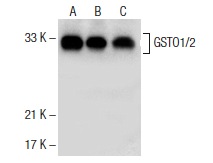
Western blot analysis of GSTO1/2 expression in Hep G2 (A), DU 145 (B) and HeLa (C) whole cell lysates.| Product Name | GSTO1/2 Antibody (FL-241) |
|---|---|
| Antibody Type | Primary Antibodies |
| Antigen Alias | epitope corresponding to amino acids 1-241 representing full length GSTO1 of human origin |
| Modification Notes | GSTO1 (glutathione S-transferase omega 1), also known as p28 or GSTTLp28, is a 241 amino acid protein that localizes to the cytoplasm and contains both an N-terminal and a C-terminal GST domain. Expressed ubiquitously with highest expression in heart, liver and skeletal muscle, GSTO1 exists as a homodimer that functions as both a glutathione-dependent thiol transferase and a dehydroascorbate reductase. Specifically, GSTO1 catalyzes the reaction of glutathione with a wide variety of organic compounds to form thioethers, a process that is essential for the metabolism and detoxification of a variety of xenobiotics and carcinogens. Polymorphisms in the gene encoding GSTO1 may be associated with the development of childhood acute lymphoblastic leukemia, Parkinson’s disease and Alzheimer disease. GSTO2 (glutathione S-transferase omega-2) is related to GSTO1 and is expressed in a variety of tissues throughout the body where it functions to catalyze the conversion of RX and glutathione to HX and R-S-glutathione. |
| Clonality | Polyclonal |
|---|---|
| Isotype | IgG |
| Host Species | Rabbit |
| Tested Applications | WBIPIFELISA |
| recommended for detection of GSTO1, GSTO2 of mouse, rat and human origin by WB, IP, IF and ELISA also reactive with additional species, including canine: |
|
| Species Reactivity | HumanMouseRat |
| Concentration | 1mg/ml |
| Purification | Affinity purified |
| Alternative Names | epitope corresponding to amino acids 1-241 representing full length GSTO1 of human origin |
|---|---|
| Tissue Specificity | epitope corresponding to amino acids 1-241 representing full length GSTO1 of human origin |
Application
Western blot analysis of GSTO1/2 expression in Hep G2 (A), DU 145 (B) and HeLa (C) whole cell lysates.| Application Notes | recommended for detection of GSTO1, GSTO2 of mouse, rat and human origin by WB, IP, IF and ELISA also reactive with additional species, including canine: |
|---|
| Form | Liquid |
|---|---|
| Storage Instructions | For short-term storage, store at 4° C. For long-term storage, aliquot and store at -20ºC or below. Avoid multiple freeze-thaw cycles. |
| Storage Buffer | phosphate buffered saline , pH 7.4, 150mM NaCl, 0.02% sodium azide and 50% glycerol. |


