Application
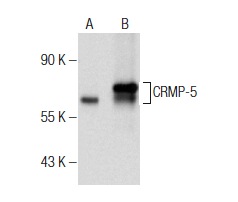
Western blot analysis of CRMP-5 expression in non-transfected: (A) and human CRMP-5 transfected: (B) 293T whole cell lysates.| Product Name | CRMP-5 Antibody (H-85) |
|---|---|
| Antibody Type | Primary Antibodies |
| Antigen Alias | epitope corresponding to amino acids 451-535 mapping near the C-terminus of CRMP-5 of human origin |
| Modification Notes | Collapsin response mediator proteins (CRMPs), including CRMP-1 (DRP-1), CRMP-2 (DRP-2 or TOAD64), CRMP-3 (DRP-4), CRMP-4 (DRP-3) and CRMP-5 (DRP-5), mediate signal transduction after exposure of neural cells to the axon guidance molecule Semaphorin 3A (SEMA3A)/collapsin. CRMPs are present in the developing cerebral cortex and neocortical neurons and are responsive to SEMA3A. In the adult brain, the expression of CRMPs is dramatically downregulated. However, they remain expressed in structures that retain their capacity for differentiation and plasticity. CRMP-5, which is phylogenetically divergent from the other four CRMPs, is expressed in the filopodia of growth cones as well as in adult central and peripheral neurons, including synapses. The paraneoplastic CRMP-5 autoantibody (CRMP-5-IgG) is also associated with small-cell lung carcinoma or thymoma. |
| Clonality | Polyclonal |
|---|---|
| Isotype | IgG |
| Host Species | Rabbit |
| Tested Applications | WBIPIFELISA |
| recommended for detection of CRMP-5 of mouse, rat and human origin by WB, IP, IF and ELISA also reactive with additional species, including equine, canine, bovine and porcine: |
|
| Species Reactivity | HumanMouseRat |
| Concentration | 1mg/ml |
| Purification | Affinity purified |
| Alternative Names | epitope corresponding to amino acids 451-535 mapping near the C-terminus of CRMP-5 of human origin |
|---|---|
| Tissue Specificity | epitope corresponding to amino acids 451-535 mapping near the C-terminus of CRMP-5 of human origin |
| Entrez Gene | 56896 |
|---|
Application
Western blot analysis of CRMP-5 expression in non-transfected: (A) and human CRMP-5 transfected: (B) 293T whole cell lysates.| Application Notes | recommended for detection of CRMP-5 of mouse, rat and human origin by WB, IP, IF and ELISA also reactive with additional species, including equine, canine, bovine and porcine: |
|---|
| Form | Liquid |
|---|---|
| Storage Instructions | For short-term storage, store at 4° C. For long-term storage, aliquot and store at -20ºC or below. Avoid multiple freeze-thaw cycles. |
| Storage Buffer | phosphate buffered saline , pH 7.4, 150mM NaCl, 0.02% sodium azide and 50% glycerol. |


