Application
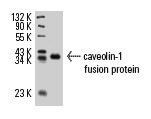
Western blot analysis of human recombinant caveolin-1 fusion protein.| Product Name | caveolin-1 Antibody (H-97) |
|---|---|
| Antibody Type | Primary Antibodies |
| Antigen Alias | epitope corresponding to amino acids 82-178 of caveolin-1 of human origin |
| Modification Notes | Caveolae (also known as plasmalemmal vesicles) are 50-100 nM flask-shaped membranes that represent a subcompartment of the plasma membrane. On the basis of morphological studies, caveolae have been implicated to function in the transcytosis of various macromolecules (including LDL) across capillary endothelial cells, uptake of small molecules via potocytosis and the compartmentalization of certain signaling molecules including G protein-coupled receptors. Three proteins, caveolin-1, caveolin-2 and caveolin-3, have been identified as principal components of caveolae. Two forms of caveolin-1, designated alpha and beta, share a distinct but overlapping cellular distribution and differ by an amino terminal 31 amino acid sequence which is absent from the beta isoform. Caveolin-1 shares 31% identity with caveolin-2 and 65% identity with caveolin-3 at the amino acid level. Functionally, the three proteins differ in their interactions with heterotrimeric G protein isoforms. |
| Clonality | Polyclonal |
|---|---|
| Isotype | IgG |
| Host Species | Rabbit |
| Tested Applications | WBIPIFELISA |
| recommended for detection of α- and β-caveolin-1 of mouse, rat and human origin by WB, IP, IF and ELISA also reactive with additional species, including equine, canine, bovine, porcine and avian: |
|
| Species Reactivity | HumanMouseRat |
| Concentration | 1mg/ml |
| Purification | Affinity purified |
| Alternative Names | epitope corresponding to amino acids 82-178 of caveolin-1 of human origin |
|---|---|
| Tissue Specificity | epitope corresponding to amino acids 82-178 of caveolin-1 of human origin |
| Entrez Gene | 857 |
|---|
Application
Western blot analysis of human recombinant caveolin-1 fusion protein.| Application Notes | recommended for detection of α- and β-caveolin-1 of mouse, rat and human origin by WB, IP, IF and ELISA also reactive with additional species, including equine, canine, bovine, porcine and avian: |
|---|
| Form | Liquid |
|---|---|
| Storage Instructions | For short-term storage, store at 4° C. For long-term storage, aliquot and store at -20ºC or below. Avoid multiple freeze-thaw cycles. |
| Storage Buffer | phosphate buffered saline , pH 7.4, 150mM NaCl, 0.02% sodium azide and 50% glycerol. |


