Application
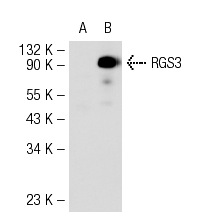
Western blot analysis of RGS3 expression in non-transfected: (A) and mouse RGS3 transfected: (B) 293T whole cell lysates.| Product Name | RGS3 Antibody (H-300) |
|---|---|
| Antibody Type | Primary Antibodies |
| Antigen Alias | epitope corresponding to amino acids 1-300 mapping at the N-terminus of RGS3 of human origin |
| Modification Notes | Heterotrimeric G proteins function to relay information from cell surface receptors to various intracellular effectors. G proteins comprise a, b and g subunits, and following activation, the a subunit binds GTP and dissociates from the bg complex. A large group of proteins have been identified as GTPase-activating proteins (GAPs), including the RGS (regulator of G protein signaling) family, which serve to deactivate specific Ga isoforms by increasing the rate at which they convert GTP to GDP. RGS3 is a protein of the RGS family that preferentially binds to the activated form of Ga11. Through this association, RGS3 inhibits Ga11-induced signaling, leading to a decrease in the accumulation of intracellular calcium and the inhibition of MAP kinase phosphorylation. RGS3 is highly expressed in adult kidney and myocardium, and it is primarily localized to the cytoplasm. Upon activation of Ga11, RGS3 translocates from the cytosol to the plasma membrane, thereby bringing RGS3 within close proximity to the targeted G protein. |
| Clonality | Polyclonal |
|---|---|
| Isotype | IgG |
| Host Species | Rabbit |
| Tested Applications | WBIPIFELISA |
| recommended for detection of RGS3 of human origin by WB, IP, IF and ELISA: |
|
| Species Reactivity | HumanMouseRat |
| Concentration | 1mg/ml |
| Purification | Affinity purified |
| Alternative Names | epitope corresponding to amino acids 1-300 mapping at the N-terminus of RGS3 of human origin |
|---|---|
| Tissue Specificity | epitope corresponding to amino acids 1-300 mapping at the N-terminus of RGS3 of human origin |
| Entrez Gene | 5998 |
|---|
Application
Western blot analysis of RGS3 expression in non-transfected: (A) and mouse RGS3 transfected: (B) 293T whole cell lysates.| Application Notes | recommended for detection of RGS3 of human origin by WB, IP, IF and ELISA: |
|---|
| Form | Liquid |
|---|---|
| Storage Instructions | For short-term storage, store at 4° C. For long-term storage, aliquot and store at -20ºC or below. Avoid multiple freeze-thaw cycles. |
| Storage Buffer | phosphate buffered saline , pH 7.4, 150mM NaCl, 0.02% sodium azide and 50% glycerol. |


