Application
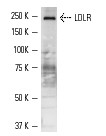
Western blot analysis of LDLR expression in CCD-1064Sk whole cell lysate.| Product Name | LDLR Antibody (H-120) |
|---|---|
| Antibody Type | Primary Antibodies |
| Antigen Alias | epitope corresponding to amino acids 701-820 mapping near the C-terminus of LDLR of human origin |
| Modification Notes | LDLR (low density lipoprotein receptor) is a member of the LDL receptor gene family, which includes LDLR, LRP, Megalin, VLDLR and ApoER2 (1). The LDL receptor family is characterized by a cluster of cysteine-rich class A repeats, epidermal growth factor (EGF)-like repeats, YWTD repeats and an O-linked sugar domain (2). The LDL receptor is a cell surface transmembrane protein that mediates the uptake of low density lipoprotein and its degradation in the lysosome, which provides cholesterol to cells (3,4). The cytoplasmic domain of the LDL receptor is necessary for the receptor to cluster in coated pits, which promotes the rapid endocytosis of bound LDL (5,6). Mutations in LDLR cause the autosomal dominant disease, familial hypercholesterolemia (FH), which promotes premature coronary atherosclerosis (4,7). |
| Clonality | Polyclonal |
|---|---|
| Isotype | IgG |
| Host Species | Rabbit |
| Tested Applications | WBIPIFELISA |
| recommended for detection of LDLR of human origin by WB, IP, IF and ELISA: |
|
| Species Reactivity | HumanMouseRat |
| Concentration | 1mg/ml |
| Purification | Affinity purified |
| Alternative Names | epitope corresponding to amino acids 701-820 mapping near the C-terminus of LDLR of human origin |
|---|---|
| Tissue Specificity | epitope corresponding to amino acids 701-820 mapping near the C-terminus of LDLR of human origin |
| Entrez Gene | 3949 |
|---|
Application
Western blot analysis of LDLR expression in CCD-1064Sk whole cell lysate.| Application Notes | recommended for detection of LDLR of human origin by WB, IP, IF and ELISA: |
|---|
| Form | Liquid |
|---|---|
| Storage Instructions | For short-term storage, store at 4° C. For long-term storage, aliquot and store at -20ºC or below. Avoid multiple freeze-thaw cycles. |
| Storage Buffer | phosphate buffered saline , pH 7.4, 150mM NaCl, 0.02% sodium azide and 50% glycerol. |


