Application
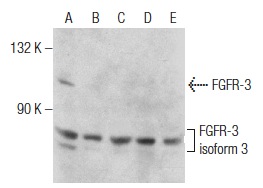
Western blot analysis of FGFR-3 expression in K-562 (A), MCF7 (B), T-47D (C) and Hep G2 (D) whole cell lysates and human liver tissue extract (E).| Product Name | FGFR-3 Antibody (H-100) |
|---|---|
| Antibody Type | Primary Antibodies |
| Antigen Alias | epitope corresponding to amino acids 25-124 mapping within the extracellular domain of FGFR-3 of human origin |
| Modification Notes | Acidic and basic fibroblast growth factors (FGFs) are members of a family of multifunctional polypeptide growth factors that stimulate proliferation of cells of mesenchymal, epithelial and neuroectodermal origin (1). Like other growth factors, FGFs act by binding and activating specific cell surface receptors. These include the Flg receptor or FGFR-1, the Bek receptor or FGFR-2, FGFR-3, FGFR-4, FGFR-5 and FGFR-6 (2). These receptors usually contain an extracellular ligand-binding region containing three immunoglobulin-like domains, a transmembrane domain and a cytoplasmic tyrosine kinase domain (3,4). The gene encoding human FGFR-3 maps to chromosome 4p16 and is alternatively spliced to produce three isoforms that are expressed in brain, kidney and testis (5,6). Defects in FGFR-3 are associated with several diseases, including Crouzon syndrome, achondroplasia, thanatophoric dysplasia, craniosynostosis adelaide type and hypochondroplasia (7–10). Mutations in FGFR-3 are also a cause of some bladder and cervical cancers (11). |
| Clonality | Polyclonal |
|---|---|
| Isotype | IgG |
| Host Species | Rabbit |
| Tested Applications | WBIPIFELISA |
| recommended for detection of FGFR-3 of mouse, rat and human origin by WB, IP, IF and ELISA: |
|
| Species Reactivity | HumanMouseRat |
| Concentration | 1mg/ml |
| Purification | Affinity purified |
| Alternative Names | epitope corresponding to amino acids 25-124 mapping within the extracellular domain of FGFR-3 of human origin |
|---|---|
| Tissue Specificity | epitope corresponding to amino acids 25-124 mapping within the extracellular domain of FGFR-3 of human origin |
| Entrez Gene | 2261 |
|---|
Application
Western blot analysis of FGFR-3 expression in K-562 (A), MCF7 (B), T-47D (C) and Hep G2 (D) whole cell lysates and human liver tissue extract (E).| Application Notes | recommended for detection of FGFR-3 of mouse, rat and human origin by WB, IP, IF and ELISA: |
|---|
| Form | Liquid |
|---|---|
| Storage Instructions | For short-term storage, store at 4° C. For long-term storage, aliquot and store at -20ºC or below. Avoid multiple freeze-thaw cycles. |
| Storage Buffer | phosphate buffered saline , pH 7.4, 150mM NaCl, 0.02% sodium azide and 50% glycerol. |


